
The challenge for schools is to avoid common misconceptions that affect learning.
Deceptive Truths
Information without sufficient context is deceptive. Students draw incorrect conclusions that affect them subconsciously when they hear deceptive truths like “life is unfair”, “beauty is in the eye of the beholder”, “truth is subjective”, and other partial truths that downplay learning. When students understand the learning cycle, they aren’t misled by partial truths because they know what learning is.
The Learning Cycle
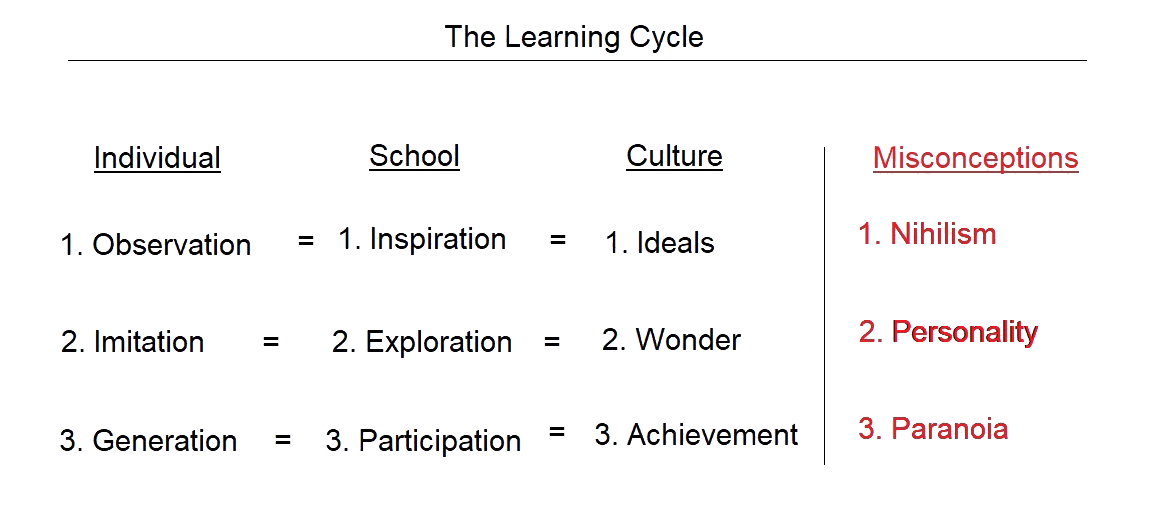
The learning cycle consists of (1) Observation, (2) Imitation, and (3) Generation, where students observe information and apply it to their lives so they can master it, which completes the cycle. They progress to the next level toward truth.
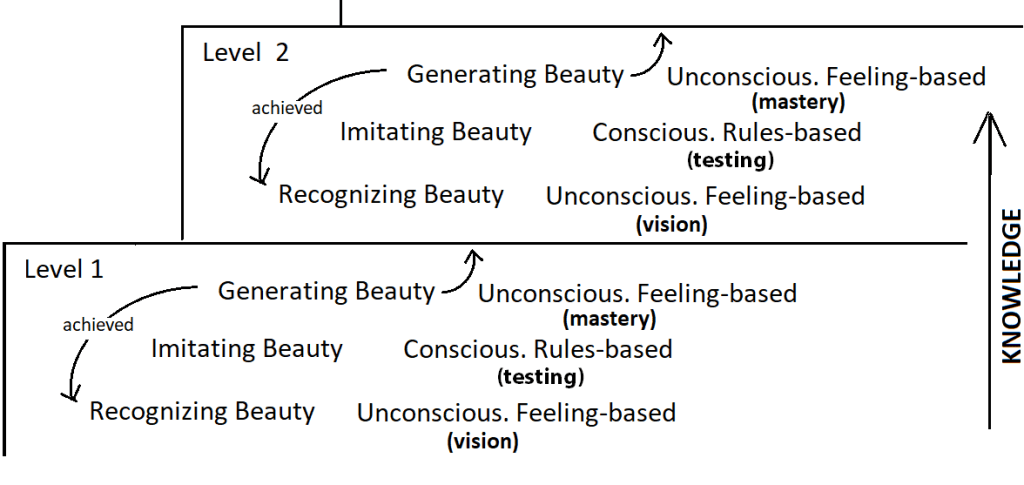
In the school environment, the learning cycle can be described as (1) Inspiration, (2) Exploration, and (3) Participation.
Developmental Psychology
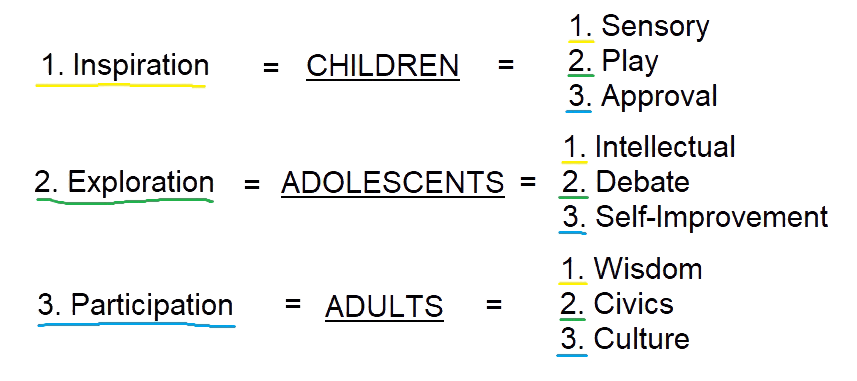
The stages of learning manifest themselves differently throughout life. Children are primarily sensory, whereas adolescents are more intellectual. At the adult level, we integrate our senses with our intellect and have wisdom. We explore wisdom through civics, and participate in culture. The three developmental stages correspond to the three stages of learning as a whole. Children represent the (1) Inspiration stage, adolescents represent the (2) Exploration stage, and adults represent the (3) Participation stage.
Attacks on Learning
Because deceptive truths appear harmless, we should start at common misconceptions and work backwards to find their causes. We recognize their prevalence when we rephrase the learning cycle as (1) Ideals (2) Wonder, and (3) Achievement. The attacks on Ideals cause (1) Nihilism. The attacks on Wonder cause (2) Personality. And the attacks on Achievement cause (3) Paranoia. Students accept these misconceptions as excuses not to learn.
 Rules For Schools