
The Process
Learning Communities
Learning communities are based on the number of students needed for each level of schooling. Early on, schools are small like daycare. More students are needed in the later grades to support advanced classes, specialization, and extra-curricular activities.
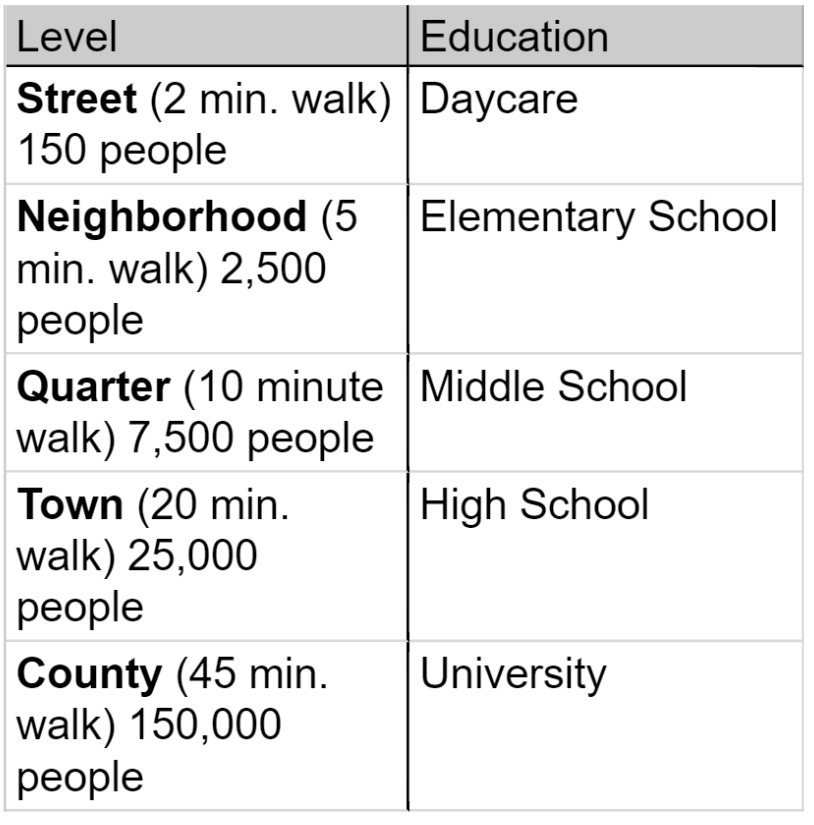
Learning communities correspond to the different levels of community. For the school to be within reasonable walk times, the density has to be at least 4 dwelling units per acre. When the density is closer to 10+ du/acre, people live closer together, so it doesn’t take as long to get to the center. In that case, the county level is more like a city, since everything is within walking distance. At that density, the city can support a high school at the neighborhood level.
Physical Communities
It’s difficult to separate the social component of learning from the physical component. An elementary school is a program as well as a building. The classroom is a social setting as well as a physical setting. Learning communities fit into physical communities based on their size.

Shared Services
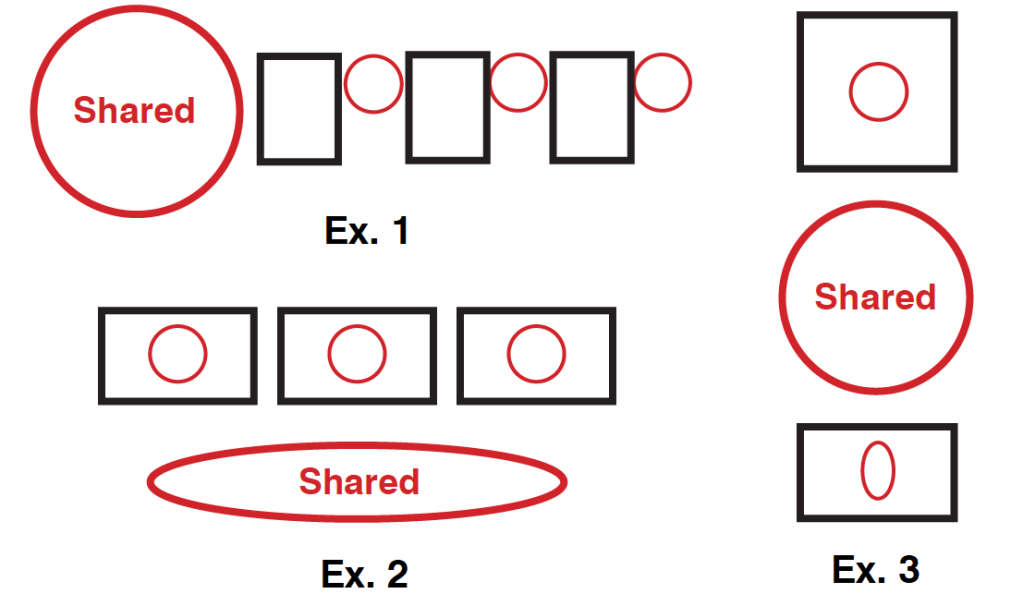
Physical communities can be defined by what they share in common. The campus, schools, clusters, and classrooms have “private” and “common” space.
- A campus has several buildings that share amenities in common, such as a sports field. The sports field is the common space, and the schools are the private space. The schools have a separate identity, whereas the sports field shares its identity between the schools.
- A school’s common space includes a gymnasium, auditorium, cafeteria, etc. Its private space (the clusters) is more private than the campus’s private space (the schools) because its frame of reference is one more private-level in.
- A cluster’s common space includes its own lounge area, restrooms, library, computer lab, science lab, etc. Its private spaces are the classrooms.
- A classroom’s common space is its single enclosure, its front board, its space for group activities, shared individual space like a lounge chair, etc. The private spaces for the classroom are the students’ individual desks, and their individually assigned cubbies.
Spatial Organization
Shared amenities make up the commons. The shared space for each community doesn’t have to be in the center, but it should be accessible from the private spaces. It makes sense to locate campus buildings around a shared central quad, but depending on the circumstances, the shared space could be associated with a specific building, or located on a different site, as long as it’s within walking distance of the private spaces.
Multiple Scales of Community
The four scales of physical community don’t cover every scenario that might exist, but they provide a useful framework. A large classroom might approximate a cluster when it’s designed as an open plan with group teaching. A middle school can have “houses” in between the level of cluster and school, with their own principal. A high school can have several buildings in a “complex”, which approaches a campus.
Physical communities are nested within each other. A middle school that requires 300 students per grade can’t increase the classroom size until it reaches that number. It must replicate the classroom until it hits a cluster, and then it must replicate the cluster until it hits a school.
Learning Community Sizes
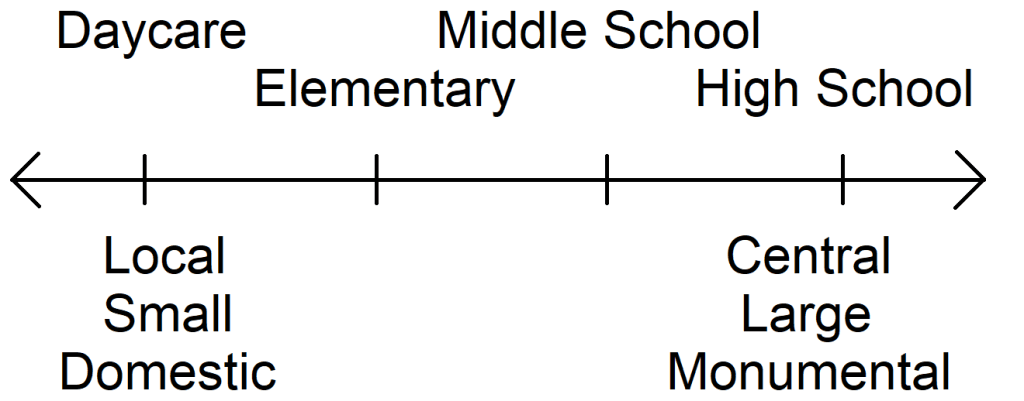
Learning communities fit into physical communities based on the number of students needed for each grade. Later grades require a larger pool of students, so they should be more centrally located in town. They should look larger and more civic because they represent more people.
- Daycares only require a single room for children, such as in a typical house. The authority figure at that level is the adult who overseas the children. Several daycares exist at the neighborhood level.
- Elementary schools only require a few classrooms, overseen by a group of teachers. They exist at the neighborhood level, where they act as a community hub. They don’t need to be much larger than the one-room schoolhouse. They should have a formal look. It makes sense to divide elementary schools into clusters. They can form separate schools depending on how large they are, with one principal overseeing K-3, and another principal overseeing 4-5.
- Middle schools can be divided into multiple buildings, given the number of clusters that are required. Separate buildings give clusters a strong identity, and they receive more natural light since the clusters aren’t attached to each other. Middle schools should be centrally located, and they should have an institutional look.
- High schools require several buildings in order to accommodate the necessary number of students. The wings (clusters) of the building can be divided by department, or by grade. High schools draw students from the whole town, so we should locate high schools in the town center. Resources exist at the high school level to build something impressive and monumental that everyone is proud of.
- Universities require a campus of buildings, with at least a few monumental buildings. They exist at the city or regional level. The university is overseen by a university president. The colleges that make up the university are overseen by the deans of the colleges.
Building Types
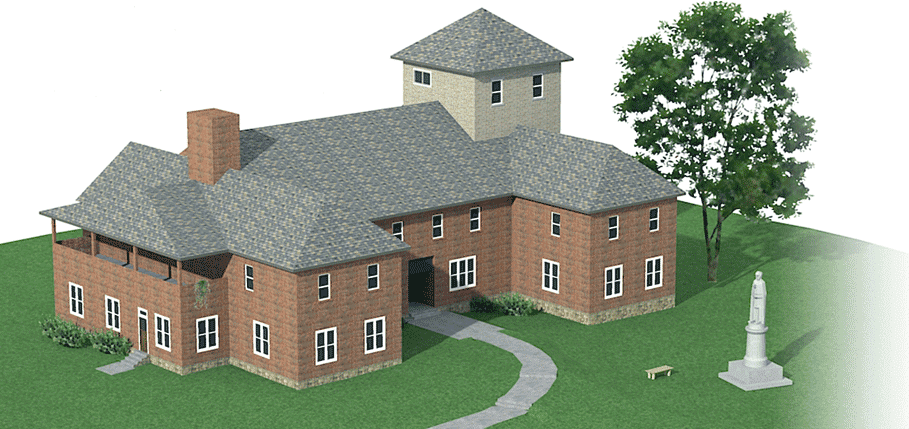
The Domestic building type has the scale of a cluster.

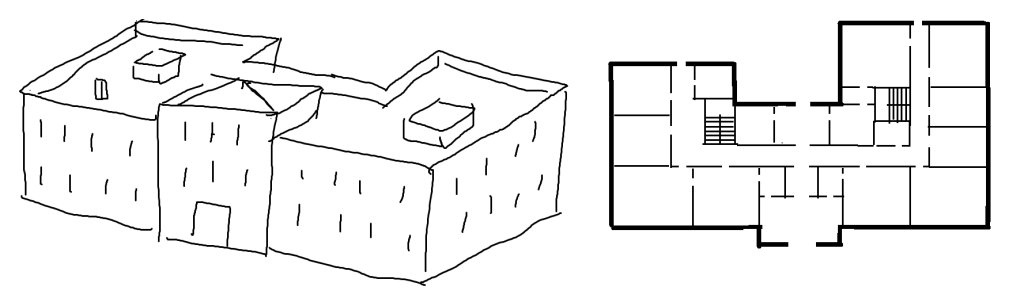
The Institutional building type has the scale of a school. It consists of multiple clusters on the same floor, which form the wings of the building. Each cluster has its own stairs, restrooms, support rooms, etc.
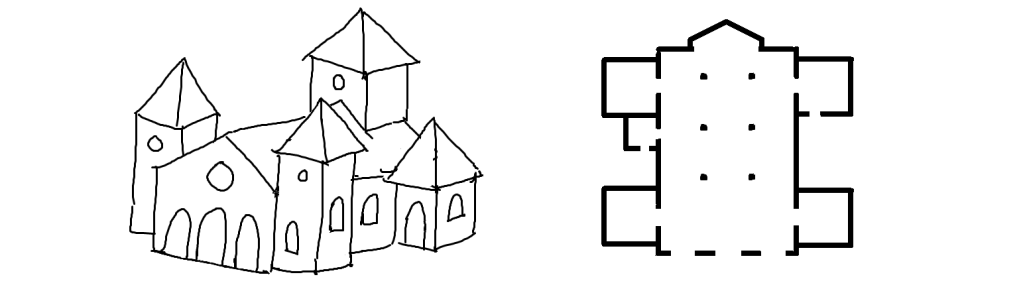
The Monumental building type prioritizes spatial experience. It can be the chapel on a university campus, or the neighborhood church. Important civic buildings should have a monumental look.
The Cluster
After elementary school, children no longer have a single class that makes up their school day. They take multiple classes with different teachers, and they have to traverse the school in order to get to their classes. For them to feel comfortable in the new environment, they need an intermediary scale of community in between classroom and school.
We can divide the school into clusters, where students only take classes with those students in their cluster. The cluster is important for creating a sense of community. The jump from classroom to school (especially in a large school), without an intermediary community, is overwhelming for students. Clusters exist at around 50-100 students. Students can get to know the students who they take the same five or so classes with. This creates closer relationships between students. Teachers can work with other teachers in the cluster.
Clusters should take over the services that are out-of-scale at the school level, such as the industrial-style cafeteria and school-wide bathrooms. Most services are better provided at the cluster level, instead of at the school level. Mega-schools should split into “schools-within-a-school”. The clusters, or small schools, can have their own faculty and budget, along with localized services. They can share between themselves the larger-scale amenities like the gymnasium and auditorium.
Spatial Presence
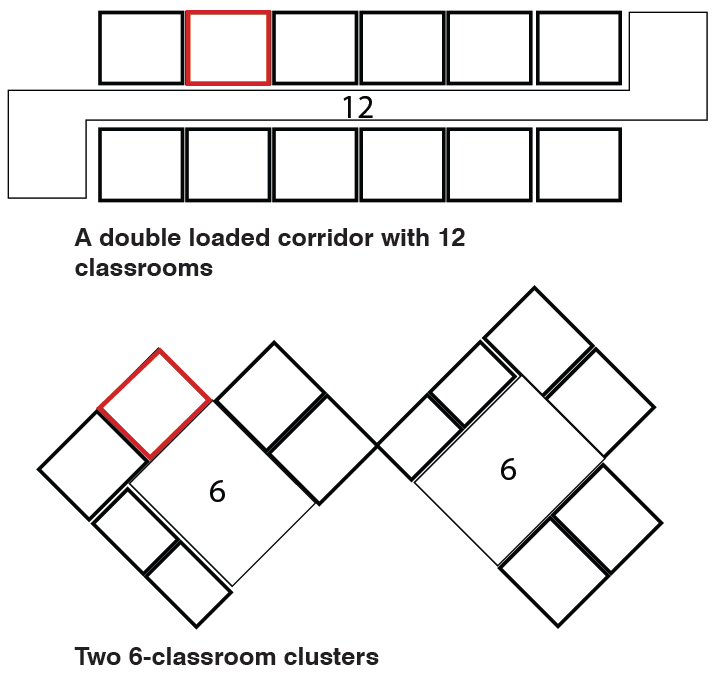
When divided into two clusters of 6, each classroom gets twice as much spatial presence. The cluster becomes a physical representation of community. Unless classrooms are organized into clusters, they don’t represent the learning community. The purpose of school is to learn. If classrooms are scattered around non-academic program, such as a cafeteria and gymnasium, the school seems more like a place to go play sports or eat lunch. The corridors aren’t considered part of the learning environment because they connect non-academic program, and they’re used by the whole school.
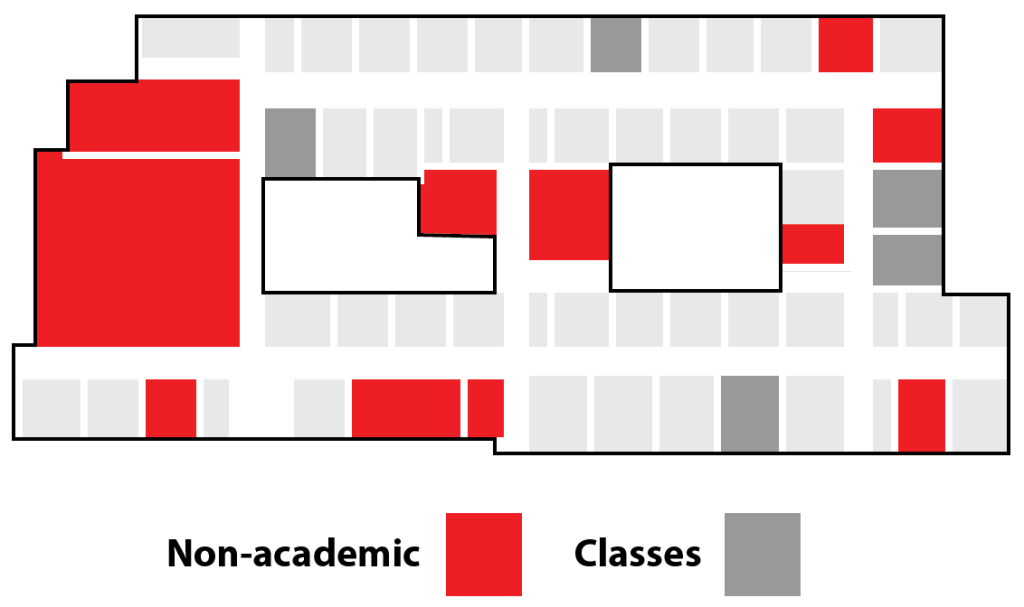
By organizing the classrooms into clusters, it strengthens their spatial presence, which strengthens the academic presence of the school. Corridors can be incorporated into the cluster as study space.
Clusters distinguish themselves from other clusters by being on separate floors, or in separate wings of the building.
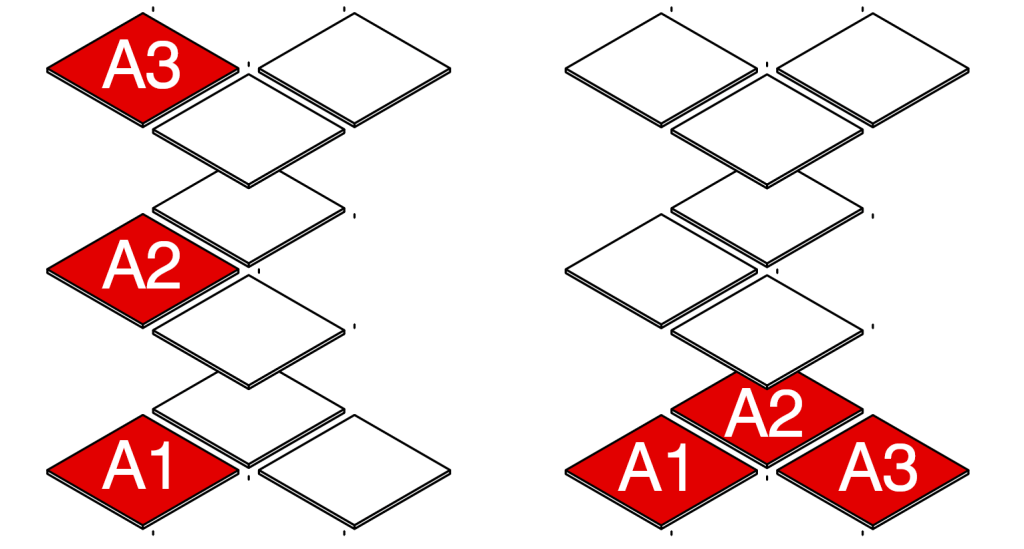
Physical separation creates a mental separation, which creates distinction. Students value their own environment because they have something to compare it to. Each cluster develops its own identity within the school.
Student Autonomy
Students feel “at home” in their cluster because they’re familiar with it, both socially and physically. They feel like they belong there. Students share the same space with other students who they take classes with. They interact with them every day, along with their group of teachers. When students aren’t comfortable in their environment, they focus on that instead of learning. Clusters give students confidence to develop their individuality. Teachers have a sense of what’s going on, so they can give students more freedom.
Student Ownership
Students see the cluster as their own space, so they take ownership of it. They’re less likely to toss gum on the floor, or to trash the restrooms, because it’s “theirs”. They experience the consequences of their actions more directly. They recognize the need to respect the space, and to “do their part”. Students supervise the common space, which reduces problems. There’s a healthy competition between the clusters, which motivates students to contribute. They feel a sense of comradery within the group.
Schools that provide social clusters but don’t represent them in built form miss an opportunity to strengthen the sense of community. Students may be in the same classes as the rest of their social cluster, but if they have to traverse the whole school in order to get there, they still run into people who they’re unfamiliar with. Teachers know the other teachers in the social cluster better when there is a physical cluster.
The Cluster Layout

At 10 classrooms, the cluster begins to split into two clusters. A cluster that’s too large loses its sense of community.

The cluster is a typical building unit. Units can be combined to create larger buildings.
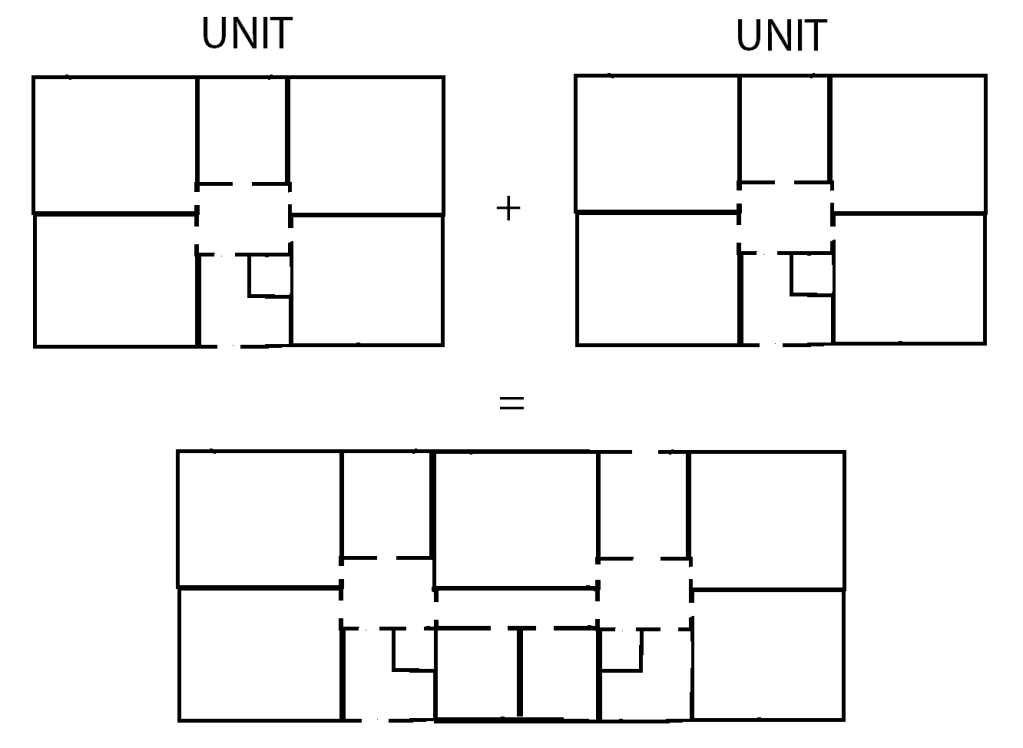
We can divide the building unit into main rooms, sub-rooms, and auxiliary rooms. Main rooms are placed at the corners to receive two sides of natural light. Sub-rooms are placed in between main rooms. Auxiliary rooms are carved out for storage or miscellaneous uses. An interior room can’t receive natural light, so it can’t be a main room, unless we combine it with a main room to let in natural light.

The interior room can be a hallway, a lounge, or a studio space. It can be combined with a perimeter room to become a main room that now has natural light.

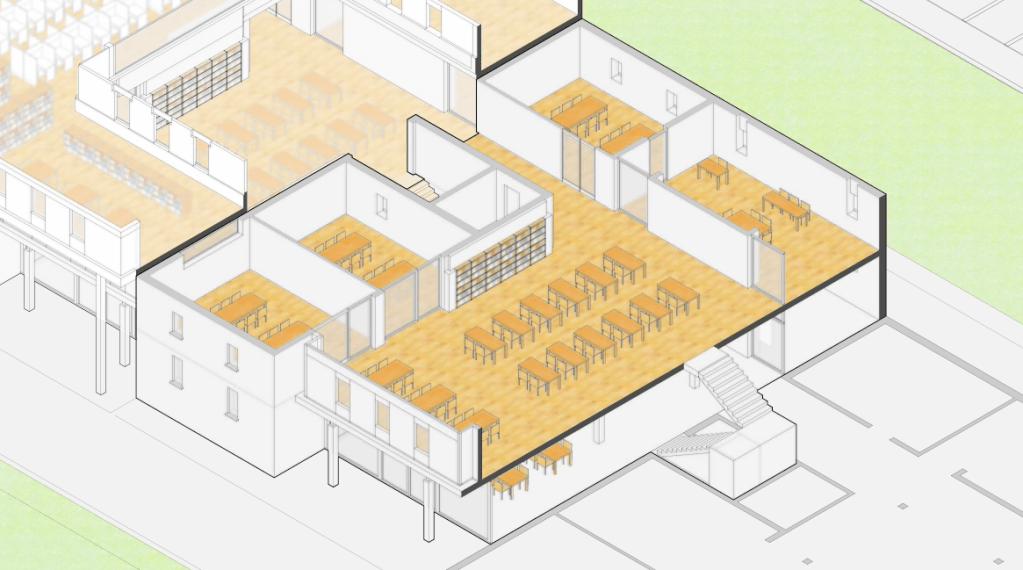
A two-story library cluster for a middle school that has natural light from the back windows, and from above
Teacher Autonomy
Clusters give teachers autonomy over the different aspects of school, such as curriculum, discipline, trips, extracurricular activities, etc. The teacher’s role in the cluster is analogous to the principal’s role in the school. The administrative functions are less bureaucratic because teachers see what’s happening on the ground, so they have more control over the situation. They can work together as a group to oversee the cluster.
Teachers work together with the other teachers for the sake of the community. This fact should be represented in physical space. Teachers oversee more than just their individual classroom. Clusters accurately represent the teacher’s contribution by portraying what the teacher does, how many students they teach, who they work with, etc. Teachers are more involved in the community when they have more jurisdiction over it. They have more stake in making sure everything works. They become better role models because they’re more involved.
Clusters extend the perception of a faculty presence beyond the classroom. It puts a face to unsupervised problem areas like hallways, lockers, and restrooms. Space outside the classroom is generally regarded as anonymous space. By linking it with classrooms, clusters bring it together as part of the learning environment. It expands the teacher’s space beyond the classroom, which extends civility beyond the classroom. Students are expected to behave at all times, not just during class. They internalize civility as a way of being, instead of something to be turned on and off according to convenience.
Teacher Authority
Students disobey the teacher when his or her authority is compromised. Physical space represents authority through owned space. Just as the cluster belongs to the group of teachers, the classroom belongs to the individual teacher. Students are guests in the teacher’s space, and it’s a privilege for them to be there. Students can modify the space, but it should be at the teacher’s discretion. It should feel like the teacher’s office. The school isn’t an abstract entity where students and teachers are thrown together as equals. Non-hierarchical space implies that everyone is the same, and that anyone could be the teacher. Physical distinction represents value through difference.
Non-Academic Program
Non-academic program includes music, art, sports, etc. Too much non-academic program weakens the perceived importance of academics. Schools should take a student-centric approach to learning, which separates the functions of the student’s day. Students don’t want to run a mile and then do math. Sports can take place in a separate building. The school café can be down the street and open to the public. If non-academic program is necessary to support academic program, such as lockers, restrooms, food services, etc., it can be combined at the cluster level without disrupting the spirit of the school.
The failure to distinguish the academic program devalues learning, and it leads to incivility. Students might talk during class if architectural cues don’t reinforce appropriate behavior. There are cultural cues built into architecture that reinforce a space’s purpose. Stacks of books evoke a library, which keeps students from talking. Seats that are modeled after church pews evoke reverence.
Civility means doing the right thing for a given situation. Running around during recess is appropriate. During class, it is not. Doing nothing is better than misbehaving, but the purpose of school is to learn. A well-ordered environment, at the cluster level, makes it easier to learn. Incivility affects everybody because the teacher has to take time away from the class to deal with it. Extreme incivility borders on criminal conduct, and the environment resembles a prison more than a school. Students are greeted with metal detectors, police officers, and drug-sniffing dogs. Extreme safety measures burden students and weaken the perceived importance of learning, but if they are necessary to prevent crime, the negative effects are outweighed by the fact that the school requires that kind of security.
 Rules For Schools