
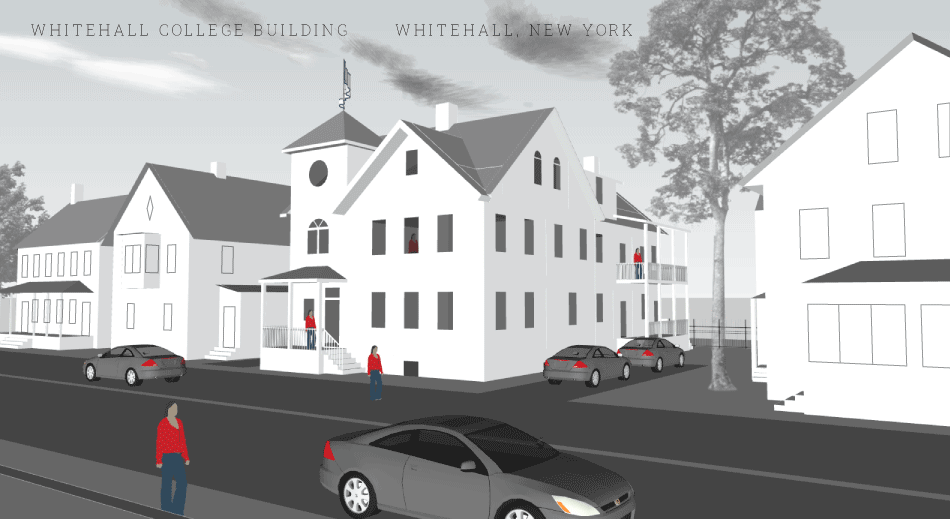
A Proposed Workers’ College in Whitehall, New York.
- A Workers’ University is a community college that doubles as an advisory board to local government.
- The advisory board consists of department heads who are experts in their respective fields. They oversee aspects of the economy that are required for good management.
- They coordinate talent within the community, so nobody is given more than they can handle, and nobody is deprived of a job.
- The department heads share what they know with future generations. They generalize the material into a K-12 curriculum.
Accountability: A Workers’ University is like an expanded planning board that functions as a community college. It promotes accountability because the department heads are well-known in the community, and people can count on them. Outside consultants often don’t know the city well, and they are only contracted for a certain period of time. An advisory board of department heads is connected to the city through the university, and their hours are not tied to a specific project. They improve the city for its own sake.
Discretion: The Deans of the Workers’ University, in their advisory roles, have a lot of say over how the town develops, which incentivizes the best people to consider the position. Young people are less willing to leave for big cities when they have options available locally. They can meet people at the university, conduct research, teach courses, and influence future generations, which many people prefer over salary. It is unfair for communities to pay for K-12 education, only to have big cities swoop in and steal the talent right before it becomes productive.
Loyalty: We do not market our innate ability as much as we do our accumulated experiences. A lot of know-how is wasted when we leave our city. We throw away the specific knowledge accumulated over many years, growing up in a specific place with specific people, knowing who is good at what, who works well with who, and what relationships exist generation to generation. It is a societal waste to lose that advantage after high school, given the collective energy that goes into it. The same loss occurs after college. As soon as enough time transpires to build relationships, everyone packs up and leaves to do it all over again, but with less success. There are fewer ties across generations, and fewer shared references. People want to know the place where they live–the historical events, businesses, landmarks, natural attractions, etc. There is meaning in walking through the cemetery where both sides of your family are buried, visiting the park where you used to play sports, passing a statue that someday might be of you, and seeing your specific knowledge put to good use, instead of it evaporating into nothing. We have a natural desire to give back to our community, and to get back to “our roots”. A Workers’ University would reinforce those instincts.
Welfare: It doesn’t help to give people money without anything to do. A 9 to 5 equivalent of welfare, known as white-collar welfare, is just as bad, even if it’s considered high-status. It is better to give people meaningful work. A Workers’ University has multiple departments to find the right job for anyone, without classifying them as a separate class of people. In many cases, the unemployed are unable to find work because their vocation has been squeezed out of society. A Workers’ University is able to support artists and musicians who serve an important role in society, even though it’s hard to quantify their contributions in terms of GDP.
Ministry of Culture: The Ministry of Culture is a joint project between several departments, established to promote art, music, film, and architecture to the extent that it benefits culture. Artists require funding in order to recoup the positive externalities that they put into society. They can monetize it themselves by partnering with business as part of a branding campaign, but that does not work for all forms of art. The best artists in the world sell their art, merchandise, and tickets, but that is because they are the best in the world, and local artists cannot compete with them. The town should not ban all outside art, but it should incentivize local art production, which people prefer anyways. It is more fun to attend a local concert than it is to put on headphones. It is more meaningful to hang up a painting by a local artist that has a story behind it. Only recently, have artists had to compete with the best in the world, and since that is a losing battle, there has been a decline in culture. There are fewer artists. Fewer people play instruments or sing because they don’t need to anymore. Individuals are worse off for it, and so is society. People should be encouraged to pursue art, and talented artists should be given the opportunity to make a living. It is unsettling to see artists working at odd jobs. People need to come together in an all or nothing way to promote culture. Otherwise, it won’t happen because people will free-ride off the benefits without contributing to it.
Full-Service Economy: Every society has a mix of skills, whether it’s ancient China, the Amish, or modern America. The compositional mix of labor is necessary for our “social organism’s” survival. At a very young age, children reach for what interests them. As they grow up, they recognize their unique abilities, and they take pride in knowing that they are needed for society to function correctly. Somebody needs to know how to build a bridge, and fortunately there is somebody who enjoys doing that. There needs to be someone to bake bread, and fortunately there is someone who is good at doing that. These things are not socialized into people because they cannot be socialized out of people. The person who is meant to be a carpenter should be a carpenter, and he or she will go to great lengths to pursue that path, despite obstacles put there by a misconfigured society.
Over-specialization: Society is overspecialized when the normal functions that make up a full-service economy are outsourced or automated. When carpentry is taken out of the local economy and given to an outside corporation, the individual who wants to become a carpenter is out of luck. He or she cannot fly to Sweden to apprentice at IKEA over the summer. If they manage to self-teach themselves the skills, they cannot compete with the products imported by IKEA. They may receive some charity from the public who now has excess spending money because of how cheap IKEA is, but that is disrespectful to the “hobbyist” carpenter, and it’s almost worse. Carpentry should be a real profession that serves a real purpose in the community. As more services are consolidated by corporations, there is less meaningful work left for the community to do. No matter how much excess money people have, they can never recreate a functioning economy because the excess wealth is a function of the takeover. IKEA can only efficientize carpentry to the extent that it takes it over. If it has been taken over, that means that people chose IKEA over the hobbyist’s furniture, and since they can only have one dining room table, it doesn’t matter how much money they give the hobbyist.
Local Production: Communities should invest in local production across all industries in order to take advantage of the compositional mix of labor. When work is overspecialized by corporations, local businesses cannot compete. Businesses fail, and cities are forced to import goods from elsewhere. The only jobs left are to work at a distribution center. The few companies that make things are so compartmentalized that it is the same as working at a warehouse. A worker who robotically flips burgers (production) has the same role as a worker who hands it to a customer (distribution). Technical jobs replace what used to be vocations. Once the vocation is destroyed, corporations call it “tedious”, so they can replace the rest of it, which further consolidates labor and capital.

Rotational Jobs: Most tedious jobs should be recaptured by their professions as part of a vocation. Those that can’t, should be offered on a rotational basis by the town to make them palatable. They should be prioritized according to the town’s immediate needs. Workers can enroll for a specified period of time to learn new skills, meet new people, or take a break from their current job. The registry of available jobs should be managed by the Workers’ University. By coordinating the work at the town level, it avoids overlapping services, and it gives workers a sense of civic pride. Corporate surrogates like big box stores and chain restaurants try to be part of the community, but they have their own branded “family”. Jobs that are administered by the town have a natural connection to the town, so they don’t have to do unnecessary team-building exercises. Workers can trust that their work directly contributes to the community.
Example: The Department of Architecture at a Workers’ University
Quality Control: Every profession has a range of talent. It’s not fair to tell less capable architects that they’re not allowed to build anything because they don’t meet the community’s standards. The right approach is to incorporate them into the process and give them projects that match their ability. Only the best architects should be designing city hall. Young architects, or less capable architects, should be helping, or designing less significant buildings. It’s more rewarding for an architect to design a small addition than it is to tell him or her that they are not allowed to work because their designs don’t cut it. Town boards often recommend firms that do good work. The planning department at a Workers’ University would formalize the process and make it more equitable.
Firm Bureaucracy: The hierarchy at a large architecture firm does not resemble meritocracy, and even if it did, most towns don’t have enough large firms to organize talent. It’s not be the client’s responsibility to know which architects are capable of doing what, and without a larger organizing body, there is no way to know which firms do good work. Review sites like Houzz focus on individual buildings and client relations instead of what contributes to the community as a whole. Lacking a support system, architects take whatever jobs they can get. Therefore, important buildings get designed by underqualified firms. Architects are careful about which firms to associate with because their name is on the building. Firms with too many failed projects can’t get young people to join. An overarching system would solve the image problem because architects wouldn’t have to justify their employment. They would be working for themselves, under the Workers’ University system.
Wasted Talent: A culture’s success depends on maximizing its potential. It doesn’t matter if a town has a hundred Rembrandts if painters aren’t free to express themselves. Architects should be given a chance directly out of college to design several buildings by themselves, without deferring to older architects. It would replace the student’s thesis year, and it would consist of a real project in the community. The better students would double the value of their budget, and the worse students would half the value of their budget, so it would be a wash, except with the added benefit of showcasing talent, and building a young architect’s portfolio. It would encourage innovation instead of getting absorbed into the “way things are”, and it would give graduates the ability to start their own firms instead of working low-level jobs.
Efficient Permitting: Architects who don’t meet the town’s standards are left guessing over something that they’re not capable of doing. The planning board isn’t capable of doing it either, or they would save everyone the hassle and do it for them. The developers waste time and money spinning their wheels each month to get nowhere. Many times, the project ends up worse than before the process started, and the board gives up and approves it anyways. Historic places rely on their charm to attract people, and low-quality development threatens that whole economy. A simplified permitting process requires basic standards that everyone can understand. Architects should know ahead of time whether or not they are capable of designing city hall.
 Rules For Schools