
Policies
Discipline: Adults should model correct behavior, so students know how to act. When teachers handle situations correctly, students notice it, and they imitate it (because they see that it works). Students learn to internalize problems in order to resolve them, instead of overreacting to them. We need discipline in order to do anything in life, especially learning, because learning requires overcoming the uncomfortable situation of temporarily not-knowing. If schools neglect teaching discipline, students won’t make good decisions in life, and society will end up paying for it. It harms disadvantaged students the most, who lack guidance from friends and family. Schools should reinforce good behavior until it becomes habit. Only then can we relax the rules, like taking off the training wheels. Clear rules provide guidance. Students know what’s expected of them, so they aren’t tempted to test out what they can get away with. When everyone is working toward the same thing, there’s a sense of community. Students don’t want to be the one to ruin it, so they feel responsible for their actions. Responsibility gives them something to be proud of. Even small successes, like having an organized workspace, proves to themselves that they can do it, which motivates them. Basic rules include being prepared for class, being on time, being well-rested, being well-dressed, being attentive; regular testing of course material, daily homework assignments; physical fitness tests, good health, confidence; good etiquette around others, etc.
Character Education: Don’t cheat and don’t steal are taught to children at a young age. The extreme versions of these things are fraud and theft, and they’re outlawed by government. Lesser transgressions are not okay simply because they don’t rise to the same level of illegality. They’re still failures of morality that we should nip in the bud. It’s not the child’s “right” to suffer from vice until he or she finally descends into criminality. Schools should protect the child in a loving way, but also in a “tough” way that parents understand. When parents are absent from the child’s life, it falls on mediating institutions like schools to step in and fill the gap. Students know that certain behavior is bad, and they want people in authority to reinforce their innate sense of right and wrong. Otherwise, they don’t trust themselves, and they succumb to antisocial trends. Our responsibility is to graduate students who will be assets to society. That means upright citizens who do the right thing even when it’s difficult. It’s worse for society to graduate top-level professionals who are clever, but lack empathy, and have no problem getting ahead at the expense of others.
Punishment: A disciplined school environment avoids distractions. Punishment can be as much a distraction as the actual offense, if it’s overly-dramatic and meant to shame the student. Students know when they did something wrong, and teachers should minimize the issue in order to resolve it. Don’t let students make more out of it than is necessary. Explain the situation logically, and give students the benefit of the doubt. Students will not continue to cause problems if they see themselves as above that type of behavior. Punishment tears the student down, which creates more of that behavior. If the student believes he or she is as bad as everyone says, they might as well act like it. The situation worsens until there are few alternatives left besides suspension. The teacher should reason with the student about different outcomes, and explain why cooperation is in the student’s best interest. It’s not a personal vendetta against the student. The teacher would rather be teaching, which is why they became a teacher in the first place. When the teacher becomes exasperated, it fuels the anxiety that the student already has, and it creates more chaos. It’s better to treat the situation in a light-hearted way, which is the reality of it.
Advanced Classes: The point of school is to match students with the correct level of ability. A mismatched class is bad for everyone. The advanced students are bored because they already know the answers. The slow students are unable to keep up, so they lose motivation. They’re embarrassed that everybody else understands the material except them. They write it off as “not their thing”, even though it could be their thing if they were presented the right material, at the right level, in the right class.
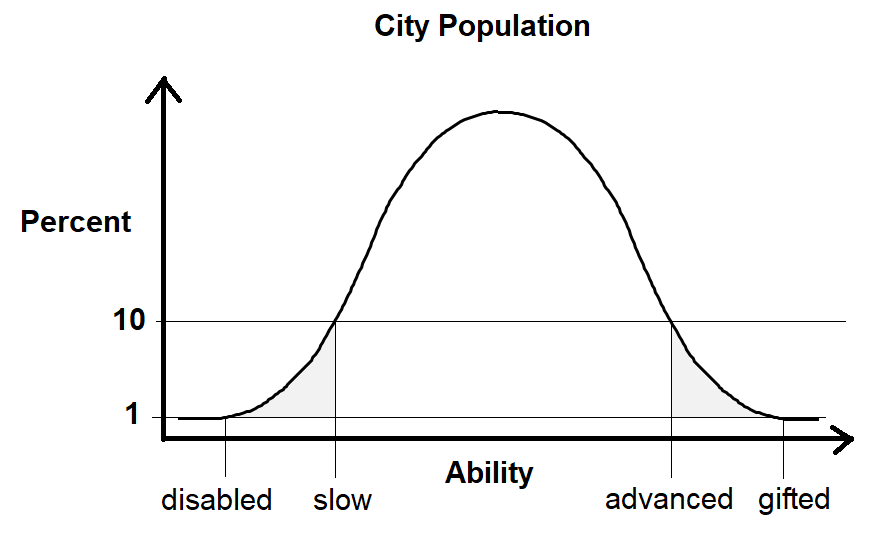
In order to find enough students of like ability, the 1% can jump 2 levels, and the 10% can jump 1 level. For example, an elementary school is at the neighborhood level, but the 1% (whether artistic, athletic, or academic) can jump 2 levels (to the city level) in order to find enough students of like ability. At the high school level, the 1% may need to jump to the college level or the regional level. The same goes for the bottom 1% and 10%, which needs to look beyond their local area to find additional resources. The percentiles should be based on the national average, in order to cover a meaningful range of ability.
Grades: Students use grades to check their progress. They need to prove to themselves that they learned something, or they won’t bother studying. Grades shouldn’t be made public unless students choose to share them with other students. The teacher should mention the top scores, and what the curve is for the class, so students have an idea of where they stand. To compete against yourself is to compete against an ideal, which leads to failure because you can always improve. The saving grace for students is to know that other students also did poorly, which reassures them that they’re not alone. Even good students can have a bad day. Students see what their relative strengths and weaknesses are, which encourages them.
Criteria: Tests should measure ability correctly. If the least capable person ends up with the highest score, it says more about the test than it does the person. Tests should measure ability, not our ability to do busywork. Top students usually do well regardless because it’s easy for them, but they will sacrifice their grade and go to the library if it isn’t worth it.
Standardized Testing: Standardized tests are useful for ability-sorting. A single test can’t measure everything, so we use multiple tests. Fitness tests don’t measure our overall worth as a person, but they’re useful for measuring physical ability. Intelligence receives outsized attention because “school” gets associated with academics, and everything else is considered a subset of that. We should legitimize all aspects of life by making them co-equal with school.
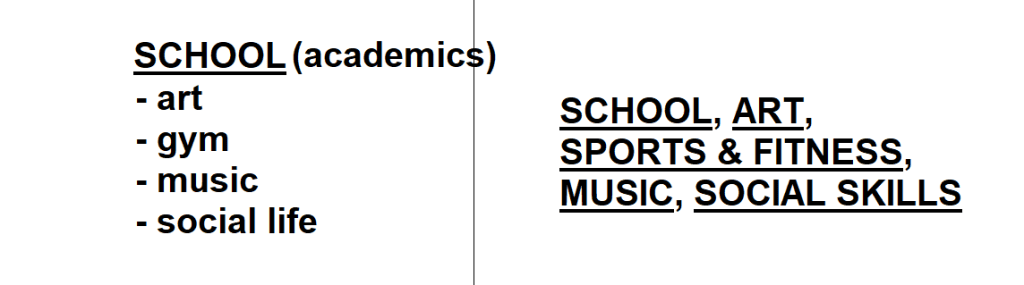
Many skills, like social skills, are difficult to quantify because they’re relational. They depend on personal interaction, which can’t be measured by bureaucratic formulae. Instead of banning testing for objective intelligences, we should find ways to test less tangible skills like charisma and kindness.
Technology: Screens should only be used for lessons that can’t be taught using other methods. The interactive aspects of computers engage students for a while, but it ultimately causes them to burn out, similar to videogames. It overstimulates their visual senses, and it denies their other senses. It disconnects them from real life, so they have to process what happened after the fact. Any activity that requires students to “plug in” to a device shouldn’t take place during school hours because it wastes the opportunity of everyone being together. Students benefit from seeing other students working because it motivates them.
Children, especially young children, should be accumulating direct experiences. If they’re denied important life lessons, because they’re in front of a computer screen, they won’t know what to program even if they become an expert programmer. High-tech tools aren’t immediately comprehensible like pencil and paper. The added complexity confuses students, and they wonder why they couldn’t be taught using simpler methods. It shifts the attention to the computer itself, instead of the point of the lesson. The connection between the hand and the brain is more natural and productive.
Parental Involvement: Children shouldn’t be separated from their parents too early on. From birth, to nursing, to crawling, infants need to be with their parents. As children become more independent, they require less attention. At around age 8, children are developmentally ready for a classroom setting. At around age 16, parental involvement becomes counterproductive. High school students are better off living away from home in supervised dorms if possible. Studies show that boarding schools avoid many of the problems associated with teenage rebellion.
Dress Codes: Outfits vary depending on context. There’s a way to dress for swimming, a way to dress for exercising, and a way to dress for learning.
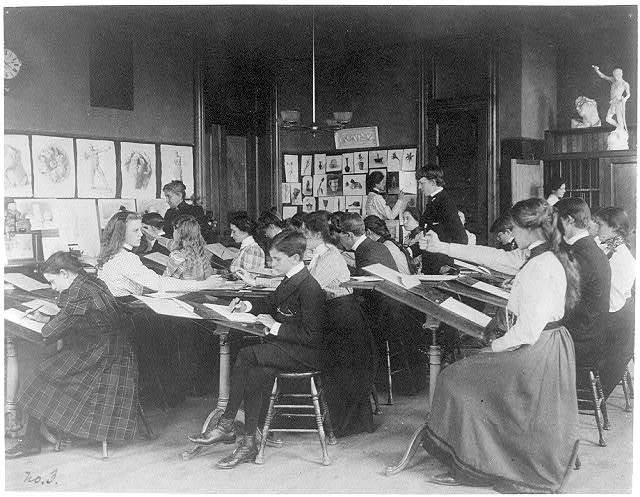
Schools take on multiple functions in society. We eat there. We play sports there. We talk with friends there. Taken together, the informal activities balance out the formal activities, and the dress code is casual. Instead of averaging out the different activities, we should separate them, and wear different outfits for each. We can wear athletic clothes for sports, semi-formal clothes for learning, and casual clothes for after school. When schools look like dorms, or sporting events, instead of places of learning, it downplays the importance of learning.
Uniforms work for group activities, like bands and sports teams, because they represent a shared commitment to the group. The dress code signals that we’re part of a community. It allows for individuality to flourish because students aren’t intentionally, or unintentionally, singling themselves out. Dress codes should be uniform enough for visual coherence. A good example is the Army, which specifies rules about attire, hairstyles, piercings, grooming, etc. When a dress code is too flexible, students call attention to themselves unnecessarily. It signals that we can’t agree on basic things.
Community Standards: Corporations take advantage of weak standards by promoting antisocial trends such as drugs, violence, activism, unhealthy dating, gambling, video game addiction, social media, etc. The trends promote destructive behavior because healthy relationships like family, friends, and community get in the way of consumerism. Corporations can’t make money from normal relationships for several reasons:
- We don’t buy inferior, commoditized versions of normal relationships, such as social media replacing in-person interaction, unless we lack the real thing.
- We don’t buy for the sake of buying, unless we’re trying to fill a void left by the lack of normal relationships.
- We don’t accept corporate exploitation, unless our community isn’t strong enough to push back (because we lack normal relationships).
Advertising uses paid entertainment to tell students what the trends are. Fashion becomes aggressive and lazy, and technology becomes isolating. Distractions paralyze students, destroy their confidence, and prevent them from learning. Students are free to make up their own mind, but they should know what the consequences are. When schools don’t offer an alternative, students are pressured into things they wouldn’t normally do. Community standards allow students to be themselves, so they can focus on what’s important.
No Identitarianism: Special interests partner with institutions to benefit themselves at the expense of everyone else. Instead of admitting what happened, failed institutions use identitarianism as a cover. They pretend that failure is a good thing because it’s “who we are”, even though it wasn’t who prior generations were. When the failure becomes too widespread to blame on genetics, they say it’s a “choice”, as if children choose to have obesity, depression, and mental illness. Instead of getting rid of the underlying problem, which means getting rid of special interests, paid “professionals” offer expensive management plans to normalize the failure as inevitable.
 Rules For Schools