
Teaching Methods

Teaching methods change as students gain more knowledge. The initial stages of learning require Direct Instruction (DI) because students don’t know anything yet. DI corresponds to (1) Inspiration. In the next stage, Self-Directed Learning (SDL), students organize the information they have received, and connect it to their existing knowledge. SDL corresponds to (2) Exploration. As students master the material, they demonstrate their proficiency by doing Student Projects (SP) which completes the cycle and turns them into teachers, at least in that instance. SP corresponds to (3) Participation.

Each individual teaching method also has a learning/teaching cycle.

The Knowledge Curve
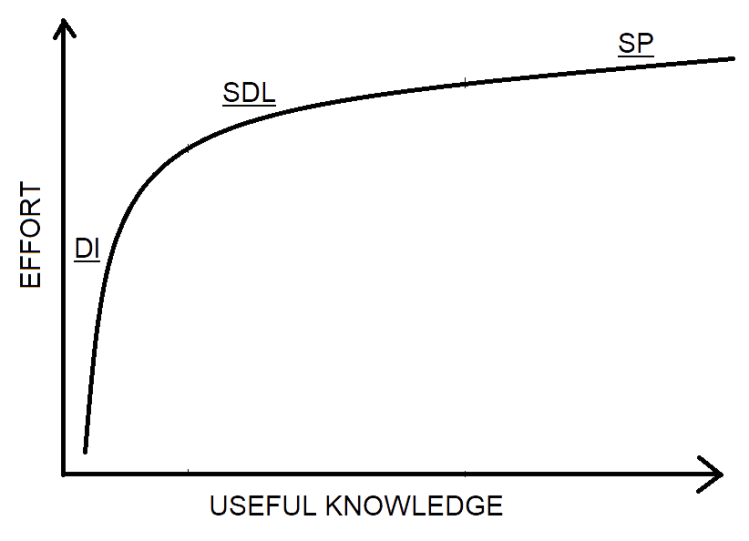
The more students know, the easier it is for them to know more. Learning useful knowledge is slow at the beginning because it requires that we build up a database first, which we draw on later as we make connections that apply to life. Early on, much of the instruction is memorization and data collection. The content includes concepts, which organizes data so that it is useful. Later on, we work with actionable information that we can do something with.
Content
If we only teach examples, like great literature, students won’t be able to recreate it because they won’t know why it is great. They will have a rich database to reference, but they can’t independently deduce rules of grammar and other literary concepts by themselves. Students need to be taught both examples and concepts. Content includes (1) Examples, (2) Structures, and (3) Concepts.
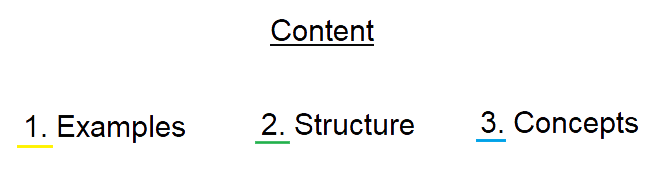
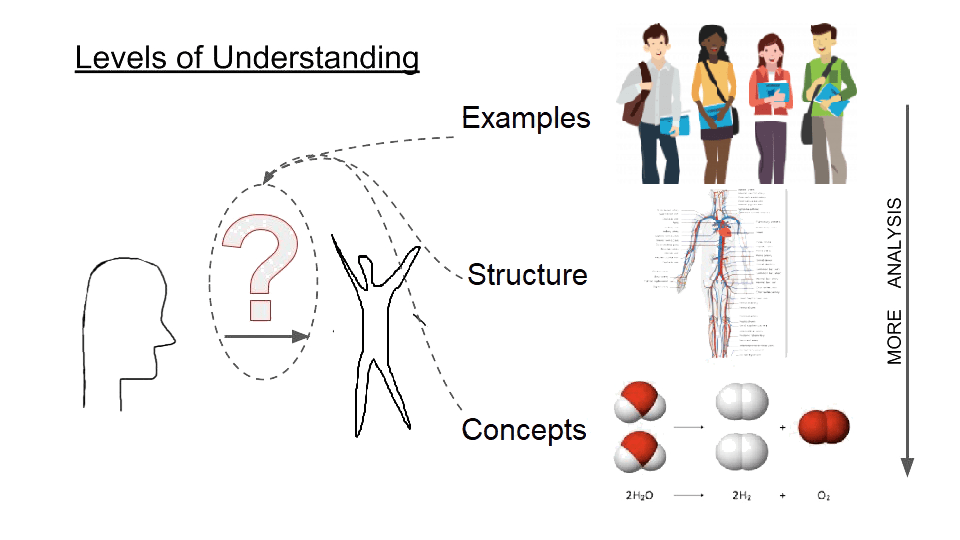
By studying Examples (DI), we can piece together a Structure (SDL) to help us discover Concepts (SP). If we only teach concepts, like grammar, it will have no grounding in reality. Concepts rely on data for their demonstration. We present healthy humans (Examples), as manifestations of anatomy (Structure), which we use to decode biology (Concepts). Once we understand biology (Concepts), we can generate healthy humans (Examples).
1. Direct Instruction (DI)
We frame our thinking around requirements in the world, such as how to grow food, or how to build houses. They are important questions that categorize information into subjects. Students don’t ask “why do I have to learn this?” when they understand the bigger picture. Inquiry-based learning inspires students with big questions about how the world works. Students pay attention to DI, either from teachers or textbooks, because that is where they find the answer. Student who lack foundational knowledge, can’t seek out additional information because they don’t know what to look for. DI prepares students for SDL.
2. Self-Directed Learning (SDL)
SDL builds on DI by allowing students to make sense of what they’ve learned. Students might think they understand what the teacher said, but unless they can do it themselves, they don’t really understand. They have gaps in their thinking. They need to test the information for themselves, and verify that it’s true. They need to struggle with the concept until everything “clicks”. Overly-predigested material deprives students of that experience. The initial period of not-knowing is what makes learning rewarding. The answer stays with us longer when we arrive at it ourselves, and we learn how to assimilate new information without becoming impatient during the investigation.
3. Student Projects (SP)
The stages of the teaching cycle are cumulative. In the final stage, students demonstrate proficiency by completing projects. They solve the big questions that motivated them in the first place. A short-term project might be a math test. Projects with a longer time-scale, such as becoming an expert, require visible milestones along the way to keep students on track. Big questions, like how to build a house, inspire lifelong goals, but intermediary projects are necessary to get there. Project-based learning (PBL) takes place at the intermediary scale. The deadline is not so far away that students lose sight of it, and it’s not so close that they’re unprepared. An example architecture curriculum proposes a project after two weeks.
Student Autonomy

Students are given more autonomy during the later stages of learning because they know more. Children are taught Core Knowledge (CK) at a young age because they don’t know what exists. They naturally defer to authority. As students learn more, they make individual choices about what interests them. Once they become adults, they specialize in professions, and become experts. The cycle completes itself because only experts can take complex ideas and communicate them in a way that children can understand as part of the general education curriculum.
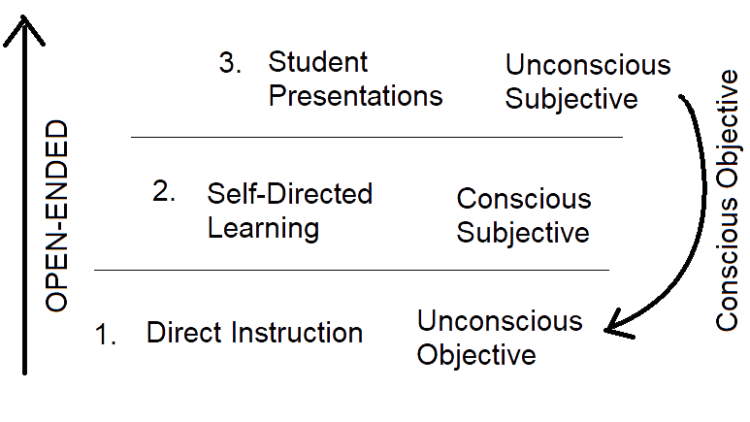
Teaching becomes more open-ended as students progress. Students begin with tightly-defined exercises as part of DI, to more open-ended research for SDL, to totally open-ended projects for SP. The final stage of specialization connects back to the first stage because once we are experts, we can present the material objectively, like how we learned it as students, before we personalized it in order to master it. The initial stage (DI) is unconscious, or feelings-based, since we defer to authority. In the second stage (SDL), we verify the information through conscious analysis as we check it against our existing knowledge. The final stage (SP) returns to unconscious action, since we become fluent with the material. In order to complete the cycle, we pass back through SDL to consciously consider how to communicate the material objectively with others (DI).
The Teaching Circle
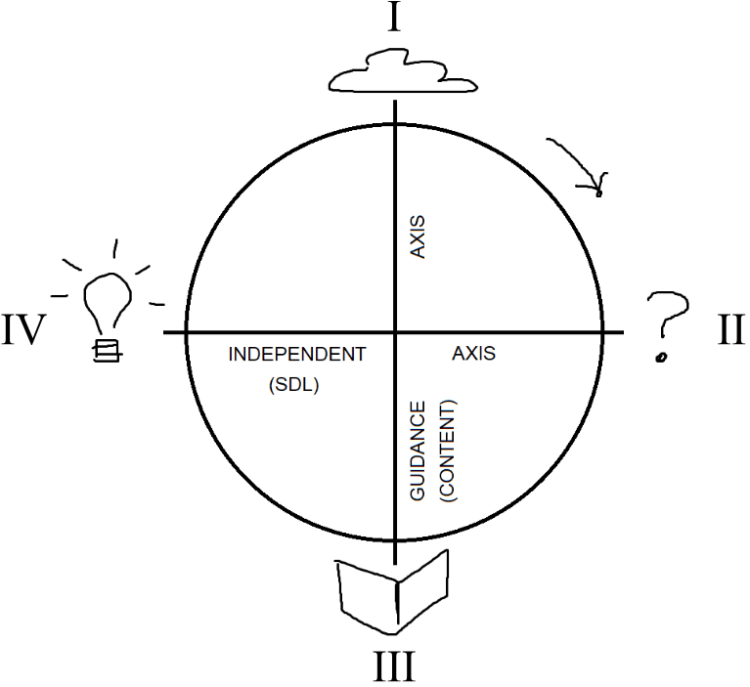
The Teaching Circle involves four stages. It explains the Teaching Cycle in more detail. The stages are either on the guidance axis (I, III), which involves teacher instruction, or they are on the independent axis (II, IV), which involves student reflection. Each stage leads to the next stage.
- Big Questions: Teachers should inspire students with big questions about how the world works. How do we heat our houses? Where do building materials come from? What does a good house look like?
- Student Imagination: Students are inspired by big questions to learn more. They consider potential answers based on what they already know. This prepares them for the next stage.
- Relevant Material: The teacher provides students with what they need to know. Students pay attention because they need the information to advance their project. The material should not be overly-predigested, or else it becomes monotonous.
- Repetition and Practice: Once the students learn the information, they test it out for themselves in order to understand it. Only then does it “click”, and they can use it creatively.
 Rules For Schools