

This article describes ways to improve culture. It is based on research from several Upstate NY towns. Part I: What is Culture? | Part II: Attacks on Culture | Part III: Future Culture
Future Institutions should reinforce normal relationships that build culture:
Institutions are necessary to uphold standards because entropy is the natural state of things. Human beings tend to follow the path of least resistance, like in nature. Institutions inspire us to do the right thing, even if we’d rather take the easy way out. Corporations take advantage of our tolerance, but it’s within our collective ability to set standards.
1. Virtue
Moral Education
Socializing children involves teaching them how to live correctly, which isn’t immediately obvious. Lessons like sharing and being kind to others, which we take for granted, take time to learn. Children welcome virtue.
Aesthetic Clues – Schools should reinforce children’s natural instincts, so they aren’t susceptible to antisocial trends. Children are good at recognizing aesthetic clues because they haven’t been conditioned out of it. They are “straight from the factory”, so they still have their factory settings. Children know that when we turn away from something, there’s a reason for it. The aesthetics of a polluted river is a clue that the fish in it will be deformed. Pollution is visually repellent, so we trust that there are consequences to letting it go unchecked. We don’t have to know exactly how pollution will harm fish to be against it. Humans evolved through trial and error to reject certain things. We can look at deformed fish and know that something went wrong somewhere along the line, without knowing exactly what.
Word Games – Students should learn common sense responses to word games. Word games pressure students into accepting antisocial trends because they’re too young to debunk the argument rationally. They can’t explain why it’s wrong, but they shouldn’t have to. By requiring explanations for everything, schools unintentionally turn students against their instincts. Students know that they’re too young to make decisions. The correct answer is “I don’t like it”, or “my parents don’t allow it”, which disarms whoever is pushing the agenda.
Mutual Benefit – The only way to benefit yourself is to benefit society. The two things are not in tension. The individual only wins if society wins, and society only wins if the individual wins. Stealing is bad for society, so it’s bad for the individual, even if it benefits the individual in the short-run. Poor health is bad for the individual, so it’s bad for society because it burdens society. “Victimless crimes” go against society, so they go against the individual, even though special interests brand them as pro-individual.
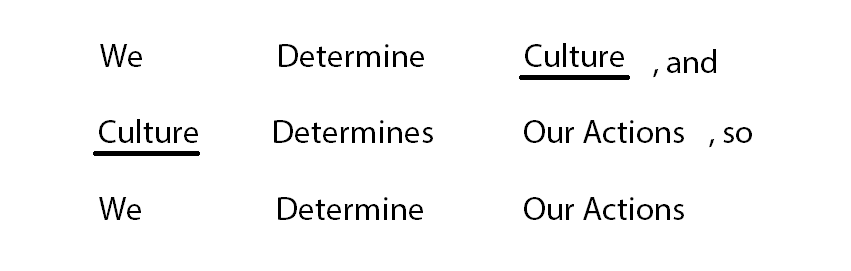
Culture Determines What We Do – Culture determines our actions, but we determine culture (with others in a democracy), so indirectly we determine our actions. In other words, we determine our actions through culture. Culture generates a range of acceptable behavior that we operate within according to circumstance.
It’s meaningless to say don’t do destructive things because everybody already knows that. Nobody chooses to have problems. We took the initial action that led to bad consequences, but culture, or the lack of culture, permitted it. It was already on the table before we chose it. Culture created it, normalized it, and didn’t offer an alternative. If most jobs are gone, it’s not our fault for being unemployed. It’s a collective problem that requires a collective solution.
2. Vocation
Meaningful Work
Meaningful work contributes to society. We take pride in our work when we recognize that our skills are necessary for society to function. We understand our role in society, so we see ourselves as part of something bigger than ourselves. Everybody is born with unique gifts, that were given to us without our choosing. When our vocation matches what we’re good at, we enjoy working. We learn to work with others because they have skills that we don’t have, and vice versa. The idea that it takes all kinds to make the world forces us to be grateful because we appreciate that we don’t have to do the things we aren’t good at. Professions get corrupted when people with no interest in the subject destroy what to them isn’t sacred in the first place. Identity isn’t something that we choose. Reality grounds us with obligations, and we “are” how we fit into that picture.
Compositional Mix of Labor
Every population has a mix of skills, whether it’s ancient China, the Amish, or modern America. Our innate talents are in proportion to what society needs. The compositional mix of labor describes how the “social organism” works. At a young age, children reach for what interests them. As they grow up, they recognize their unique talents, and they take pride in knowing that they’re needed for society to function correctly. There needs to be somebody to bake bread, and fortunately there’s somebody who likes doing that. There needs to be somebody to build bridges, and fortunately there’s somebody who’s good at that. Interests aren’t socialized into people because they can’t be socialized out of people. The person who’s meant to be a carpenter should be a carpenter, and he will go to great lengths to pursue that path, despite obstacles from a misconfigured society. We can’t determine the compositional mix of labor by looking around at what exists because many jobs have been squeezed out of society. If people can’t make a living doing what they’re meant to do, they do something else, which distorts the economy. It’s not good to educate students for the “real world” when the real world is distorted.
The Sectors:

Population Size
Babies need to be born 50-50 male-female for reproduction to work. The population doesn’t start approaching a reliable 50-50 split until we have a large enough sample size. In the same way, the compositional mix of labor doesn’t reliably occur until we have about 10,000 people, which is the population of a town. Below that size, there isn’t enough talent in each sector. The implication is that the town is the correct level of community for most things.
Local production creates a full-service economy, which feels like a community. Some functions require centralization, like automobiles and laptops, which exist at the regional level. In those cases, the community outsources its labor and capital. Trade is allowed, like importing oranges during the winter, but we shouldn’t displace local production.
Over-Specialization
The compositional mix of labor is the right amount of specialization, but corporations want to over-specialize. Society is over-specialized when the normal functions that make up a full-service economy are outsourced or automated. Factory farms know that a certain percentage of the population wants to be farmers, but they don’t want competition, so they get rid of the jobs. When carpentry is taken out of the local economy, and specialized by an outside corporation, the individual who wants to be a carpenter is out of luck. They can’t fly to Sweden to apprentice at IKEA. Even if they manage to self-teach themselves the trade, they can’t compete. They may receive charity from the public who has excess money because of how cheap IKEA is, but it’s disrespectful to the “hobbyist” carpenter, and it’s almost worse. Carpentry should be a real profession that serves a real purpose in the community. As more professions get consolidated by corporations, there’s less meaningful work to do in the community. No matter how much excess money people have, they can never recreate a functional economy because the extra spending money is a function of the takeover. IKEA only “efficientizes” carpentry to the extent that it takes it over. If it’s taken over, that means that people choose IKEA over the hobbyist’s work, and since they can only have one dining room table, it doesn’t matter how much money they give the hobbyist.
Local Production vs. Mass Production
Towns should invest in local production in order to take advantage of the compositional mix of labor that exists in the community. When work is overspecialized by corporations, small businesses can’t compete, and towns are forced to import goods. The only jobs that exist are to work at a distribution center. Chain restaurants and big box stores take over the town. A worker who robotically flips burgers (production) has the same skills as a worker who hands it to a customer (distribution). Production and distribution are the same thing when work becomes tedious. Good jobs disappear, along with the middle class. Wealth gets concentrated in fewer hands after each “inevitable” transformation of the economy.
- The artisan economy to the industrial economy
- The industrial economy to the service economy
- The service economy to the knowledge economy
- The knowledge economy to the digital economy
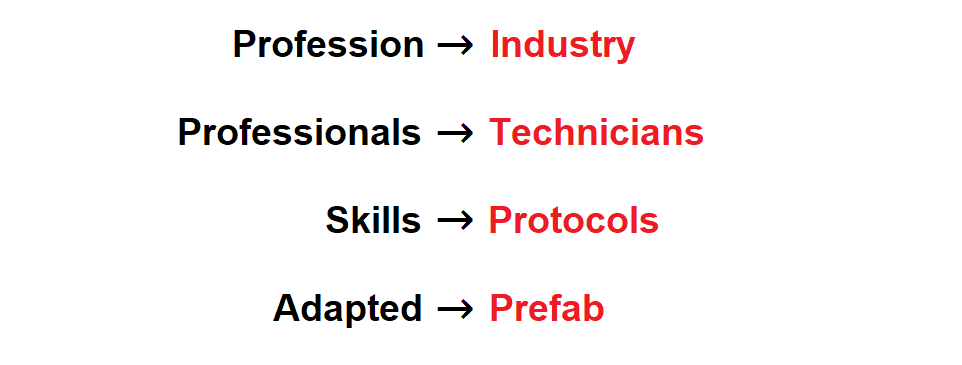
Corporations want mass production so they can scale-up profit. Mass production destroys vocations by replacing skills with protocols, which are administered by technicians. Labor is expensive because it takes time to learn skills. Corporations want unskilled labor to reduce their costs.

Unlike a town doctor who knows his patients and the profession, over-specialized technicians aren’t connected to the profession, so they have no problem doing what the hospital tells them. The hospital does what the insurance companies tell them, and the insurers do what the pharmaceutical companies tell them. The vocation is gone, so the system defaults to pushing pills and other quick fixes.
Corporations want to commodify vocations, so technicians can administer protocols. Protocols lead to bad outcomes because they’re unresponsive to context. It removes the relational component, so professions becomes bureaucratic. Once the vocation is gone, corporations call the work “tedious” so they can take it over and “liberate” us. Skilled labor unifies production with management under a single entity known as “the profession”. Skilled labor is necessary for innovation. We can’t test out ideas when “production” consists of unskilled workers halfway across the world.
Over-consolidation centralizes labor and capital beyond efficiencies of scale. Industry is fine with failure as long as they control enough of the market to act as a monopoly. They want to maximize profit, which means maximizing market share, which means maximizing mass production. If they cared about quality, they wouldn’t exceed efficiencies of scale in the first place.
Context-Dependency
The degree to which mass production harms the profession depends how context-dependent it is. Context-dependent professions can’t be mass-produced without a drop in quality. Context-independent industries, such as airplanes and computers, are not context-dependent, so their quality is less affected by mass production.
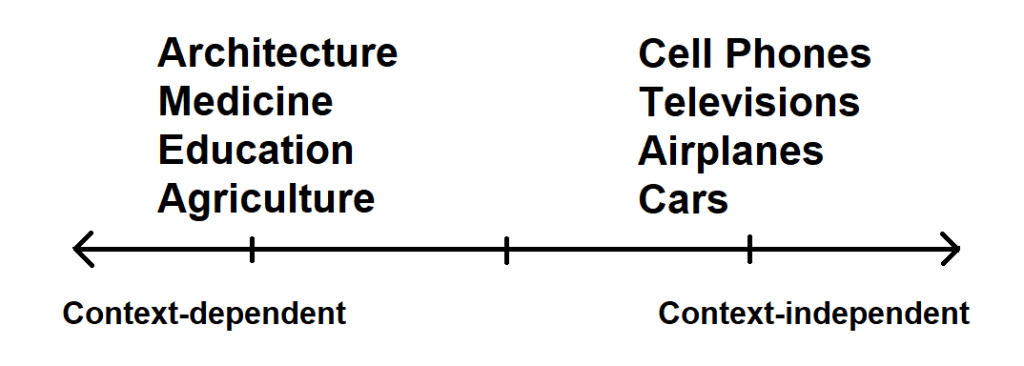
All goods and services have some aspects that are context-dependent. Creativity is context-dependent because it relates to the human experience. A car is not context-dependent, but car design is. A plane might go fast, but the travel experience is bad. A cell phone might have unlimited storage, but its interface is annoying. The context-independent aspects benefit from mass production, while the context-dependent aspects suffer from increased bureaucracy:

Context-dependent professions have a relational quality that is at odds with mass production. They get worse as mass production increases. We can’t mass produce a doctor-patient relationship. We can’t mass produce a teacher-student relationship. Their success depends on how well they respond to unique circumstances. An architect listens to his client and studies the site. A doctor listens to his patient for symptoms and causes.
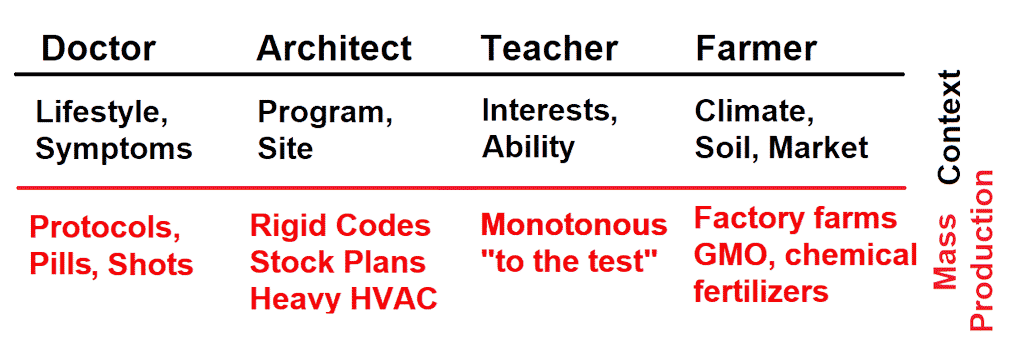
In order to adapt to context, we need skills. Professionals learn skills from the profession. Industry hires technicians to follow protocols.
Professions allow us to pursue our interests, develop skills, uphold standards, contribute to society, make a living, enjoy our work, and take part in a meaningful vocation.
Professional Standards
Professional associations uphold standards for the good of the profession and society. Architects require that buildings meet baseline standards before issuing a permit. Doctors take an oath of office to do no harm. Professional standards protect the profession from irrelevance. Professions lose their status when they no longer require skills. Meaningful work turns into BS jobs, whether it’s pushing paper or pushing boxes. Architecture turns into code compliance. Medicine turns into pill-pushing. The profession keeps the same name, but it bears no resemblance to what it was. The outcomes are completely different. Workers waste their potential doing busywork, so they feel useless. They complain about salaries and coworkers because nothing important got done.
The corporate response to job dissatisfaction is to legalize illegal sedatives. Society is encouraged to sedate itself on entertainment, drugs, alcohol, stocks, gambling, etc. It temporarily relieves anxiety, so people aren’t motivated to change the situation. Professional associations like the AIA and the AMA exist to fight corporate corruption, but they need to be held accountable. If workers are sedated, institutions only face pressure from one side, so they give in.
Craftsmanship
Craftsmanship captivates us because we recognize its quality. The work appears sincere and authentic. When we’re absorbed in our work, the human spirit shines through. It’s enjoyable because it engages all of our senses at once. It becomes a performance like a dancer, or an athlete who’s “in the moment”. We have enough context to make decisions.
Compartmentalization
Work is not rewarding when we don’t know what we’re doing. We need to know enough context to do the task. If an intern is told to deliver a set of architectural drawings, but they don’t know the deadline, they’re unable to use discretion. They might as well be a robot. If there’s a weather emergency, should they wait until the next day? They don’t have enough information to make an informed decision. If an intern is told to survey a building without knowing what it’s for, what level of precision should they use? Should they spend an hour getting quick dimensions, or should they spend the whole day measuring everything to the nearest quarter-inch?
Corporations use compartmentalization to appear efficient. Each person interacts with just enough of the project to complete their task. As long as everyone performs their role in the assembly-line process, it’s considered a success, regardless of the end result. But the end result is the reason for specialization in the first place. The whole point of job titles and billable hours is to create a final product that’s worth the effort. If the final product is worse than nothing, it doesn’t matter how much energy went into it, or how professional everybody was. Workers want to trust that the end result aligns with their values. They want to know that they’re contributing toward something good.
Professions need to be interdisciplinary because it’s impossible to weigh two things against each other without knowing both things. An architect cannot decide whether an aesthetic consideration is more important than a structural consideration, unless the architect also knows engineering. An engineer can’t tell the architect which one is more important because the engineer doesn’t know architecture. Teams of specialists can work with each other, but they can’t teach each other their professions. General knowledge is necessary for making decisions.
Training vs. Vocation
Being a technician is not the same thing as being a professional. Training is memorization without the ability to self-improve. Technicians are unable to evaluate what they’re doing because they don’t have a deep understanding of it. They don’t know how it connects to everything else, so they’re unable to respond to new information. They either 1) see the pattern that they’re trained to execute, and they execute it, or 2) they don’t see the pattern, and they don’t execute it. They’re not fluent enough in the subject to understand what’s happening.
- Technicians don’t enjoy their work because it’s tedious.
- They don’t vary in skill (beyond showing up and getting along) because their tasks are binary.
- They can be trained relatively quickly without a background in the subject.
The more splintered the profession, the more useless the “professionals”, and the more they act like technicians. When technicians are writing training manuals, it has gone full circle.
Job Prospects
Workers respond to more than just salary. It doesn’t matter how much money corporations pay workers if the work is tedious, the outcomes are bad, and the messaging is bad. People don’t want to be associated with something that is environmentally and socially damaging. If the majority of jobs are bad, workers don’t bother looking, even if good jobs exist. There has to be a critical mass of good jobs.
- Good jobs teach valuable skills.
- Good jobs are part of the community.
- Good jobs hire family, friends, and neighbors in a way that makes sense and isn’t “cold-calling”. Young people aren’t going to work for some random company.
Anti-Technology
When we commodify the professions, we get worse outcomes. Special interests call the worse outcomes “technology” or “progress” to confuse non-scientists. They invent new metrics to hide the failure. Bad outcomes include low test scores, over-prescription of drugs, pyramid schemes, synthetic food, plastic goods, etc. Technology is whatever we put our energy towards. Schools could have provided computers in the past, but screen learning isn’t optimal, so we directed our energy toward successful outcomes, even though software companies make less money. Cell phones can’t be considered progress if they lead to worse outcomes, like anxiety. Automation can’t be progress if it takes away professions that people enjoy doing.
Anti-technology disconnects us from reality, so our conscience doesn’t kick in. It’s similar to being in a casino. The outside world is shut out, so we spend all day there until we run out of money. It’s meant to numb us so we don’t look out the window and realize that we have things to do. Even productive computer work feels empty on some level because it lacks social interaction. Walking around town on vacation feels more substantive than computer work, even if on paper we didn’t accomplish anything. People who work remotely talk about their job because they want in-person assurance that, “I’m not just wasting my time, right?”
Value over GDP
Not all professions count equally for GDP. Homeschooling a child is equivalent to hiring a tutor, but it’s not counted as GDP because it’s done in-house. Similarly, the “stay-at-home” neighbor, who builds trust in the community, creates value without being counted in the GDP. Without community support, nothing gets done. People don’t get involved in local projects. There’s stress, hostility, and fewer social programs. By getting to know our neighbors, we understand that “we’re all in this together”.
Communities, in the long-run, are more productive than corporations, as long as we measure value correctly. We have to price negative externalities into the cost. Corporations are socially and environmentally damaging, so they cost more.
3. Community
The community is responsible for matching people with ability. When people do what they’re meant to do, there’s prosperity.
- When people are under-qualified, they inevitably fail, even if they could have succeeded at a lower level. They’re overwhelmed, so they don’t develop their potential.
- When people are over-qualified, they waste their potential at low-level jobs. Their talent becomes a hobby, but it should be their vocation.
Society suffers because people are doing the wrong things. Meritocracy is more humane to the individual, and it’s more humane to society.
Ability
Along with innate interests, people are born with an innate intelligence that should be developed as far as possible. Intelligence refers to more than academics. Ability is a function of intelligence and time. Ability develops with time. A gifted child, for example, has a head start because of their intelligence, but they can be surpassed over time if they don’t develop it. Intelligence is passed down at the individual level through heredity. At the societal level, it’s passed down through culture.
Classes
General awareness, which is simplified as “intelligence”, is hereditary. General awareness is the basis of classes, which describe hierarchy.
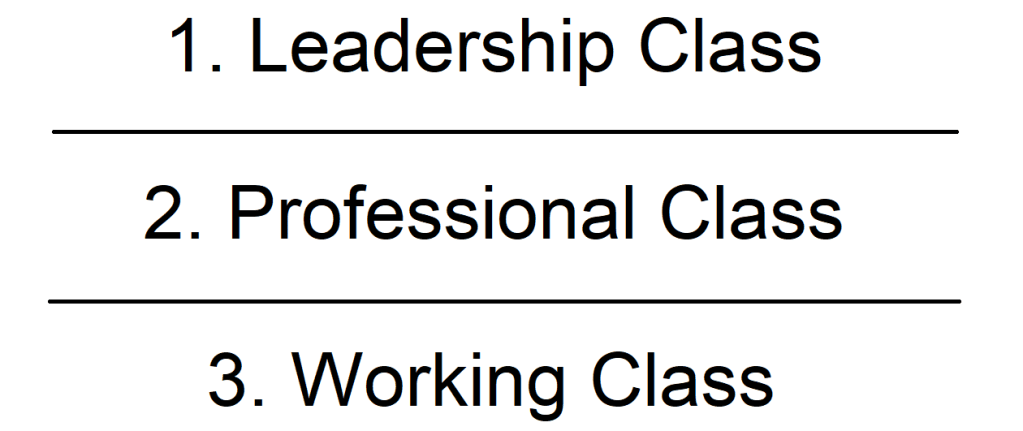
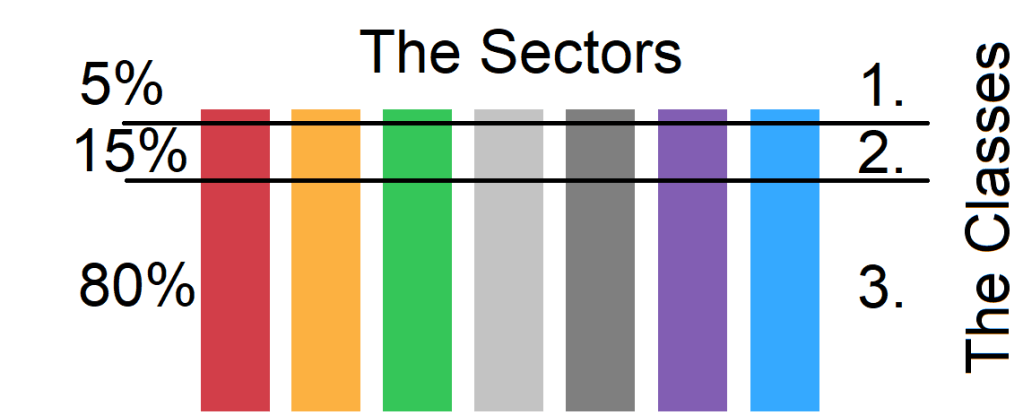
Leadership is not equally represented in the population, which is why the rare “genius” is such a gift to society. The Leadership class is the top 5% of the population, the Professional class is the next 15%, and the Working class is the next 80%.
One of the signs of “genius” is success across multiple fields, which is why it’s difficult to categorize geniuses, and we refer to them as polymaths. Their intelligence allows them to amass knowledge quickly. The more they know, the more connections they make, which increases their knowledge exponentially. Innovation follows a Pareto distribution, which is another way to look at a Bell Curve. If the difference between outcomes is insignificant, then it’s not an innovation because it’s average, which is a normal distribution.
Classes exist across sectors. A working class carpenter, for example, has more in common with a working class policeman than with a professional interior designer, even though the interior designer is in the same sector (architecture) as the carpenter. Each class has a hierarchy within it. Someone in the 94th percentile is different from someone in the 86th percentile, even though they’re both in the professional class. If somebody’s ability is in the top 5% of their sector, they’re part of the leadership class regardless of what their job title is. The leadership class tends to be visionaries who set the agenda for their profession. They are presidents, CEOs, inventors, celebrities, etc.

The clustering of ability suggests class demarcation. The demarcations of 5%, 15%, and 80% have few people on the margins, which matches our experience. Most people self-identify with a group, and their outcomes are tied to that group. The reason that ability hovers around certain benchmarks is because learning follows group dynamics. Our circle of friends create local maxima. We excel by being around people of like ability.
Class Interdependence
- The Leadership class consists of the top percentile of each sector. They don’t mind associating with failure because they’re confident in their ability to fix it. They have a vision for the profession that lifts everybody up.
- The Professional class mediates between the leadership class and the working class. They’re talented, but they don’t have vision. When they see their profession failing, they go into something else.
- The Working class depends on management from the professional class, just as the professional class depends on vision from the leadership class.
When the system is broken, the least capable professionals take on leadership roles because they don’t know any better. They’re used by special interests to degrade the profession, and it becomes a vicious circle. Once the profession hits rock bottom, it’s only fair to hire from the lowest class because it doesn’t matter at that point. The skills are gone, so anyone can perform the “work”, even if it looks out of place.
Collective Decisions
The leaders of each sector work together to make collective decisions. The criteria for ability is determined by the sector itself because they’re the most qualified to assess their field. Criteria includes qualities like intelligence and charisma, which are necessary for leadership. Self-referencing is an objective way to measure ability using statistics. It’s a weighted form of representation that resembles citation analysis in scholarship. If the right people rise to leadership positions, we don’t need bureaucratic oversight because leaders will act in the public interest for the sake of the profession. Special interests can compromise institutions, so there should be checks and balances in the form of electoral politics. A governor, for example, can restructure a state board for failing to fix internal problems. Getting the right people into positions of power unifies institutions because they share the same (correct) views. Their disagreements are minor and nuanced because they’re basically at the truth.
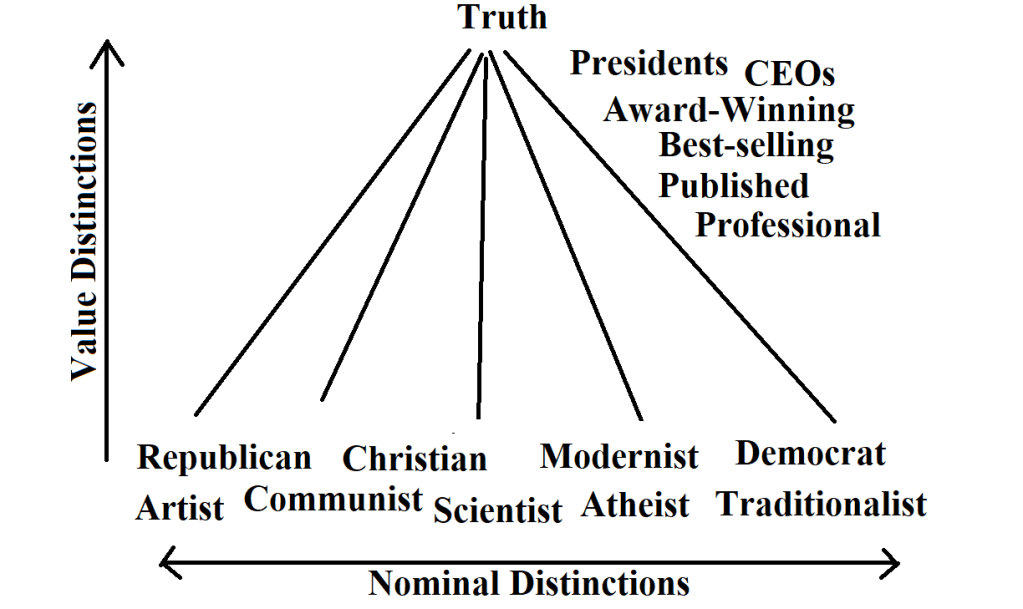
In any meaningful sense, an average Republican is closer to an average Democrat than a Republican senator, even though they’re both Republicans. It’s a whole different world with senators because they know policy and write laws. They study the same subjects, go to the same schools, know the same people, and are friends with each other. They self-reference each other. Value distinctions measure ability or meaning, whereas nominal distinctions, such as political party, measure loyalty.
Workers’ Universities
A Workers’ University is a community college that doubles as an advisory board to local government. The advisory board consists of department heads who are leaders in their respective fields. They oversee the aspects of the economy that require good management. Department heads are well-known in the community, and people trust them. They’re connected to the city through the university, and unlike consultants, their work isn’t tied to a specific project. They improve the city for its own sake. They coordinate talent within the community, so nobody is given more than they can handle, and nobody is deprived a job. The department heads share what they know with future generations by teaching college courses and developing a K-12 curriculum.
The department heads, or deans, of the Workers’ University, in their advisory roles, have a lot of say over how the town develops, which incentivizes the best people to consider the position. Young people are less likely to leave for megacities when they have local options. They can meet people at the university, conduct research, teach courses, and influence the profession, which people prefer over salary. It’s unfair for towns to pay for K-12 education, only to have big cities swoop in and steal the talent before it becomes productive. It leads to a talent drain.
Talent Drain
We don’t market our innate ability as much as we do our accumulated experiences. A lot of know-how is wasted when we leave our hometown. We throw away the specific knowledge accumulated over the years, growing up in a specific place, with specific people, knowing who’s good at what, who works well with who, and what relationships exist generation to generation. There’s a specific way of talking and behaving that characterizes the place. It’s a societal waste to lose that advantage after high school, given the collective energy that goes into it. The same loss occurs after college. As soon as enough time transpires to build relationships, everyone packs up and leaves to do it again, but with less success. There are fewer ties across generations, and fewer shared references, such as the history, landmarks, people, etc. People want to know about the place where they live. There’s meaning in walking through the cemetery where both sides of your family are buried, visiting your old childhood park, passing a statue that someday might be of you, and seeing your specific knowledge put to good use, instead of it evaporating into nothing. We have a natural desire to contribute to our hometown, and to give back to our community.
Welfare
It doesn’t help to give people money without anything to do. White-collar welfare (a BS 9 to 5 job) is just as useless, even though it’s considered high-status. It’s a way to keep up appearances. Corporations redirect their profit back into communities in the form of paychecks. People who are too proud for welfare sign up for “unofficial” welfare. It looks like a job, but it’s a money transfer. It takes people out of the economy on behalf of corporations.
It’s better to give people meaningful work. A Workers’ University would have multiple departments to find people the right job. In many cases, people aren’t able to find work because it has been squeezed out of society.
Ministry of Culture
The Ministry of Culture is an elected board from several departments that promotes art, music, film, and architecture to the extent that it benefits culture. Artists require funding in order to recoup the positive externalities that they put into society. They can try to monetize it themselves by partnering with businesses as part of a branding campaign, but that doesn’t work for all forms of art. The best artists in the world sell their art, merchandise, tickets, etc. but that’s because they’re famous. The town shouldn’t ban outside art, but it should incentivize local art production, which people prefer anyways. It’s more fun to attend a local concert than it is to put on headphones. It’s more meaningful to hang up a painting by a local artist that has a story behind it. Only recently have artists had to compete with the best in the world, and since that’s a losing battle, there has been a decline in culture. There are fewer artists. Fewer people play instruments and sing because they don’t need to. Individuals are worse off for it, and so is society. People should be encouraged to pursue art, and talented artists should have an opportunity to make a living. It’s unsettling to see artists working at odd jobs. People need to come together in an all or nothing way to promote culture. Otherwise, people will free-ride off the benefits of culture without contributing to it.
Rotational Jobs
Most tedious jobs should be reunited with their vocation. Those that can’t be salvaged should be offered by the town on a rotational basis to make them more palatable. They should be prioritized according to the town’s immediate needs. Workers can enroll for a specified period of time to learn new skills, meet new people, and take a break from their current job. The registry of available jobs would be managed by the Workers’ University. By coordinating work at the town level, it avoids overlapping services, and it gives workers a sense of duty. Big box stores and chain restaurants try to be part of the community, but they have their own branded “family”. Rotational jobs have a natural relationship with the town, so they don’t require unnecessary team-building.
Ecological Balance
Populations naturally distribute according to what’s balanced. They form cities, towns, and villages. There are a few places with many people, and many places with a few people. It follows a power law distribution. The exponential function has a base of about 3.
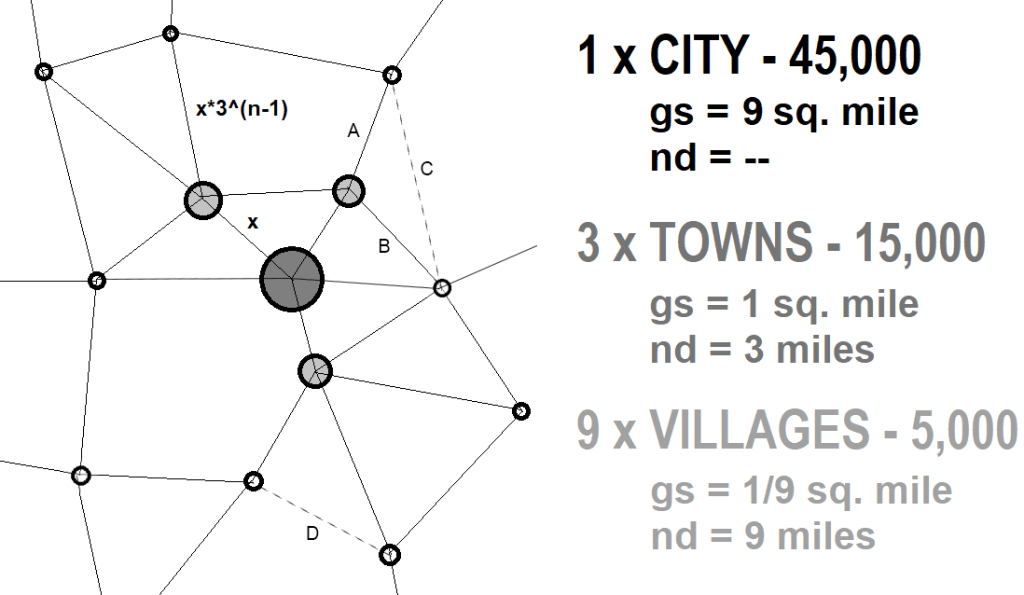
Mass production centralizes labor and capital into megacities. Over-consolidated megacities swallow everything up, which disrupts the natural balance. Megacities require intensive machinery once the limit is passed. Past a certain point, “efficiencies” of scale become inefficient. “Solutions” like factory farming lead to bad outcomes, which is a clue that they’re not solutions. There are natural limits to growth. If we can’t feed people sustainably in megacities, it’s a sign that we shouldn’t have megacities. We should decentralize agriculture, which shifts people out of megacities, and gives them something to do.
Revitalize Old Towns
We shouldn’t clear-cut forests to make room for sprawl when perfectly good towns already exist. We already invested the time, energy, and talent to build them. We should reuse what we already have, so it doesn’t go to waste. It doesn’t make sense to build new houses when we already have high-quality houses sitting empty. Beautiful Victorian and Craftsman houses are well-built, and it doesn’t take much to rehab them. Old towns are pleasant and walkable, and they have beautiful parks and main streets. They have centuries of history behind them, and it means something to live there. We should revitalize old towns by bringing back jobs. People left old towns because the jobs left. To bring back good jobs, we should:
- Coordinate local production as a main street experience.
- Train workers according to what they like to do.
- Set quality-of-life standards that price in the damage done by corporations, so small business can compete.
We should approach revitalization from multiple angles at once. We can’t go issue by issue because they’re all connected. A complete solution considers everything together, so we don’t have unintended consequences.

Civic Life
A few families can’t provide the time and energy necessary to fix failing towns. It has to be an all-or-nothing proposition from a critical mass of people. Remote workers can move in from the city and use their salary to support local businesses. As the town develops, it shifts from a bedroom community to a full-service economy. Eventually, residents can forgo their remote-work salary for full-time work in town. The goal should be for self-sufficiency.
Old towns are desperate for investment because their economies were hollowed out by over-consolidation. Corporations offer to give some of it back, but not at the same quality of life. Low standards damage the town’s biggest asset, which is its main street. Big-box stores, fast food chains, gas stations, etc. are not selling points. People won’t buy property and start businesses unless there’s a guarantee that low-quality development won’t ruin their investment. Engaged volunteers should supplement the town’s planning board where it lacks resources. Small towns don’t have the staff to do everything, so residents should get involved.
Ownership Society
We should encourage homeownership so people feel connected to where they live. If the town appreciates, property values go up, and homeowners benefit. Renters lose out because landlords charge higher rents. Locals know the town, and they contribute to the town, so it’s a waste for them to leave. Towns should:
- Manage an interest-free credit union funded by future appreciation. The interest is paid back through increased property values.
- Sell blighted properties to residents under special agreements that require them to make repairs. Training for that, as well as other skills, should be offered through a Workers’ University.
- Charge people according to what they contribute to the town. Tax absentee landlords and speculators who don’t utilize their property. Reduce property taxes for those who add value. Subsidize businesses that provide good jobs.
- Provide apartments and multifamily units near the center of the town where there are services and public transportation. Not everyone needs to own a house.
Natural Development
Natural development looks better because it expresses how we live. It evolves organically over time, which requires less planning and less financing. The major impediments to natural development are bad zoning regulations and bad financing. Towns should:
- Simplify the permitting process so people can build for themselves, using toolkits provided by the town.
- Implement high standards. It improves the town’s reputation, which attracts investment.
- Prioritize main street development. The town center is the heart of the community, so it should be subsidized until it can support itself.
4. Family
It Takes a Village
Parents are responsible for raising their children to be responsible adults. If parents fail, society has to deal with the consequences. It falls on all of us to maintain standards because we all live together. If children “slip through the cracks”, it affects everyone. Children grow up to be part of society, so we can’t ignore them and hope they go away. They’re going to be part of our life whether we like it or not, bagging our groceries, renting apartments, sitting next to us on the bus, etc. How they act is determined by how they were raised. Are they courteous? Are they good at their job? Are they committing crime?
Family Order
Children copy their parents. When parents overreact, children see that as acceptable behavior. It frightens the child to see the person responsible for their well-being unable to handle the situation. Similar to how a dog senses when its owner is stressed out, children can sense when there is chaos. Parents should demonstrate how to act correctly so children internalize their problems and overcome them, instead of being overwhelmed by external pressures. Children take out their frustration on others in order to justify what’s already inside of them. Out-of-control children aren’t the fault of parents because parents can’t help it either. It’s a cultural problem that requires a cultural solution. Broken families and unwanted pregnancies aren’t a fact of life.
A Living Wage
People can’t buy a house or start a family if their job doesn’t pay well. Corporations replace good-paying jobs with unskilled labor in order to reduce their costs. Society makes up the difference by supplementing low wages with welfare programs. The worker doesn’t feel like they’re contributing to society because they’re taking more than they’re contributing. They can’t see themselves supporting a family because they can barely support themselves. It’s not the worker’s fault because his vocation was taken from him and replaced with unskilled labor. Skilled labor pays a living wage because it requires skills. Skills give us a sense of worth because we can do things that other people can’t. It provides stability, so we look forward to the future. We participate in civic life. We think about getting married. We’re open to helping others because we don’t have to worry about ourselves.
Future Generations
People who want to get married and start a family shouldn’t be prevented from doing so. Polls show that low marriage rates and low birth rates are due to circumstances outside of their control. It’s not an individual preference to not have children beyond a certain point because negative birthrates end the population. Species don’t decide to go extinct. They stop repopulating when they’re poisoned by pollution and driven from their habitat.
Worker bees aren’t needed for reproduction because they have other functions that are necessary for the hive’s survival. Evolution looks at reproduction holistically. Not every person needs to have children in order to contribute to society. Priests play an important role even though they don’t have children. The problem is when people who want to have children can’t. If half the population isn’t having children, it’s a clue that something has gone wrong.
Healthy Relationships
Families that raise children right are a benefit to society. Healthy relationships are the basis of society, whereas unhealthy relationships damage society. We should get rid of obstacles that prevent healthy relationships, instead of promoting unhealthy relationships as a quick fix. We should get rid of toxic chemicals that disrupt our biology. Instead of accepting failure as normal because it’s common, we should recognize that it can’t be normal at that rate. We should fix the underlying problems instead of benefitting off failure to make money. We can’t commodify natural processes. Organic development can’t be “stitched together”.
Courtship
We shouldn’t promote unhealthy relationships that paralyze young people. Young people should meet other young people through productive activities that are both spontaneous and structured. Courtship leads to healthy relationships. It benefits both the individual and society. If courtship breaks down, individuals retreat from dating because there’s a stigma associated with it, since it’s not related to marrying. Young people don’t bother participating because even if they “succeed”, it doesn’t lead to a healthy relationship. Young people shouldn’t have to spend money at bars, restaurants, and concerts in order to socialize. Towns should identify popular places to hang out.
Courtship formalizes dating instead of gossip. In the same way that a teenager might date someone from another school to avoid scrutiny, social media bypasses the normal safeguards of family and friends. It’s easier to pretend to be something else when parents, teachers, and peers aren’t part of the equation. We can’t provide feedback if we don’t know what’s happening. The student doesn’t treat it as real life. It becomes an escape, like having a girlfriend or a boyfriend in a video game. Virtual dating is fantasy unless it turns into courtship and in-person dating. Texting or calling leaves out important context. Since we can’t get a full picture, we fill in the missing pieces ourselves. We’re always going to assume the best, which is why courtship requires knowing the person.
People have in-group preferences, which makes it difficult to find a spouse in a different country. For the sake of younger generations, we should consider dating prospects when deciding public policy. If half of the dating pool comes from another country, is that good or bad? If they speak another language, and have a different culture, is that good or bad according to in-group preferences? If it’s bad, then we reduce the chances of pair bonding by half. We should give young people the best possible chance to have a family because that’s what improves the school system and the community.
 Rules For Schools