
Ideals are what inspire students to improve. They are the goal of learning, so when we attack ideals with deceptive truths, we devalue learning in the eyes of students, and they become nihilistic.
Science Always Gets Disproven
Ideals are attacked by de-legitimizing science unintentionally. We imply that because science continuously gets perfected, it can never be right. Its value becomes null after every new discovery, and since there will always be new discoveries, why bother to learn something that will eventually be disproven? This deceptive truth furthers the misconception that learning is a never-ending journey instead of an ever-inward clarification.
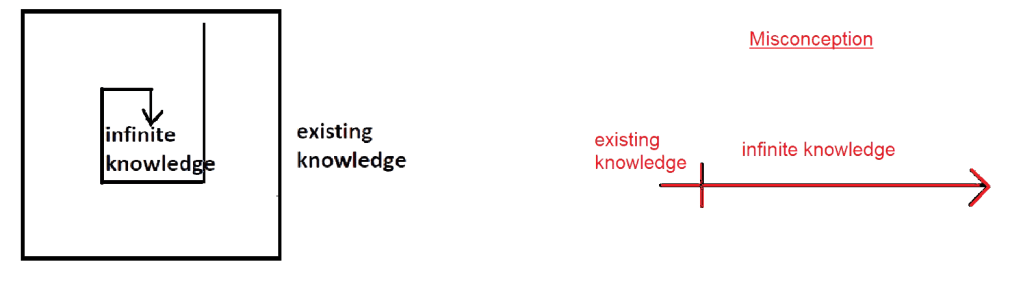
New discoveries clarify existing knowledge. If new information was equal to existing knowledge, we would never know anything relative to what is left to know (infinity).
Only Physical Sciences Are Objective
Based on the prior misconception that today’s science might be worthless tomorrow, science becomes a hobby for other people because it is not central to our lives. It is painted into a corner and restricted to the physical sciences. This error takes science out of ethics, aesthetics, and the social sciences, and we believe that only the physical sciences can reach a consensus, and everything else is opinion. This is deceptive because even the physical sciences are based on opinion. If I disagree with a physics paper, that is my opinion. If a child reads it, they don’t understand it. To them, physics is not real. To a blind person, color is not real. Science means a consensus based on self-referencing and other checks that can be statistically proven. That is how we know Shakespeare is better than most people at writing, and that murder is wrong. Some people might dispute these things, but that does not make them opinions. It makes those people wrong, just like the people who can’t understand physics or colors. We are not all equal in our understanding of science, so one person’s view will not be the same as another’s. But this does not mean that there isn’t a hierarchy of value called science that we strive to understand and contribute towards.
Beauty is in the Eye of the Beholder
“Beauty is in the eye of the beholder” is true in the same sense that intelligence is in the brain of the beholder. Life has an experiential side, but that does not negate reality. It is because of reality that we have a subjective experience of it. The goal of learning is to bring our subjective selves up to higher objective standards. Improving taste is like building a physical muscle. We don’t know it exists until we have it, and then it affects how we experience the world. When engineers learn physics, they see objects differently because they understand how physics works. Developing our taste enriches how we see the world. We experience life more fully because we have more “taste” buds. We are more sensitive to what has value. We are better at judging value and creating value. Deciding which paintings to hang up in a museum (judging) is the same as deciding which colors to put on a canvas (creating). If we tell students that it’s all opinion, they won’t put in the effort because why bother.
We Can Only Learn From People Who Look Like Us
We should not restrict valuable information, even if not everybody in the world can relate to it. If Shakespeare is translated into Chinese, and given to Chinese students, they will benefit from reading it, but they have their own books that reveal the same truths in a way that is better suited for them, which relates to their history and culture. In America, we should present material in a way that connects to our history and culture. This is the foundational works of Western civilization, which are also taught around the world. If we have to know the rest of the world’s references, there is no point in having communities, which allow us to understand the macrocosm by understanding our own microcosm. Truth is contextual, so it looks different in different situations. That is why it is difficult to make ethical decisions without specific context.
History is Subjective
Experts do not present different accounts of history based on their nationality. Textbook authors are American, Japanese, German, Russian, and everything else. If only winners write history, then Japanese and German experts would not be allowed to write about WWII. The search for truth is more meaningful to historians than their nationality. That is why Germans can be honest about Hitler. Preferences exist, but we separate it out from impersonal matters of history. There is a consensus on controversial issues at the highest levels of knowledge.
America is Bad
Schools have a responsibility to caution students against incorrect conclusions. Noam Chomsky and Howard Zinn accept America’s founding principles of democracy, meritocracy, rule of law, the jury system, federalism, and checks and balances as so obvious, they take a niche approach, and specialize in finding examples throughout history that do not reflect those ideals according to their research. Students without a foundational understanding of America will take the niche textbook and think it is an overall textbook, which both authors disagree with. Without foundational knowledge, students will only have the niche information when they think of America. They will see no reason to apply themselves in a country that does not reward talent and good ideas. It’s an example of how a little bit of knowledge can be dangerous. Everything is true in some sense, so schools should find what is most valuable and explain it to students in a way that benefits them.
 Rules For Schools